A assustadora história por trás do mito do Minotauro em Creta

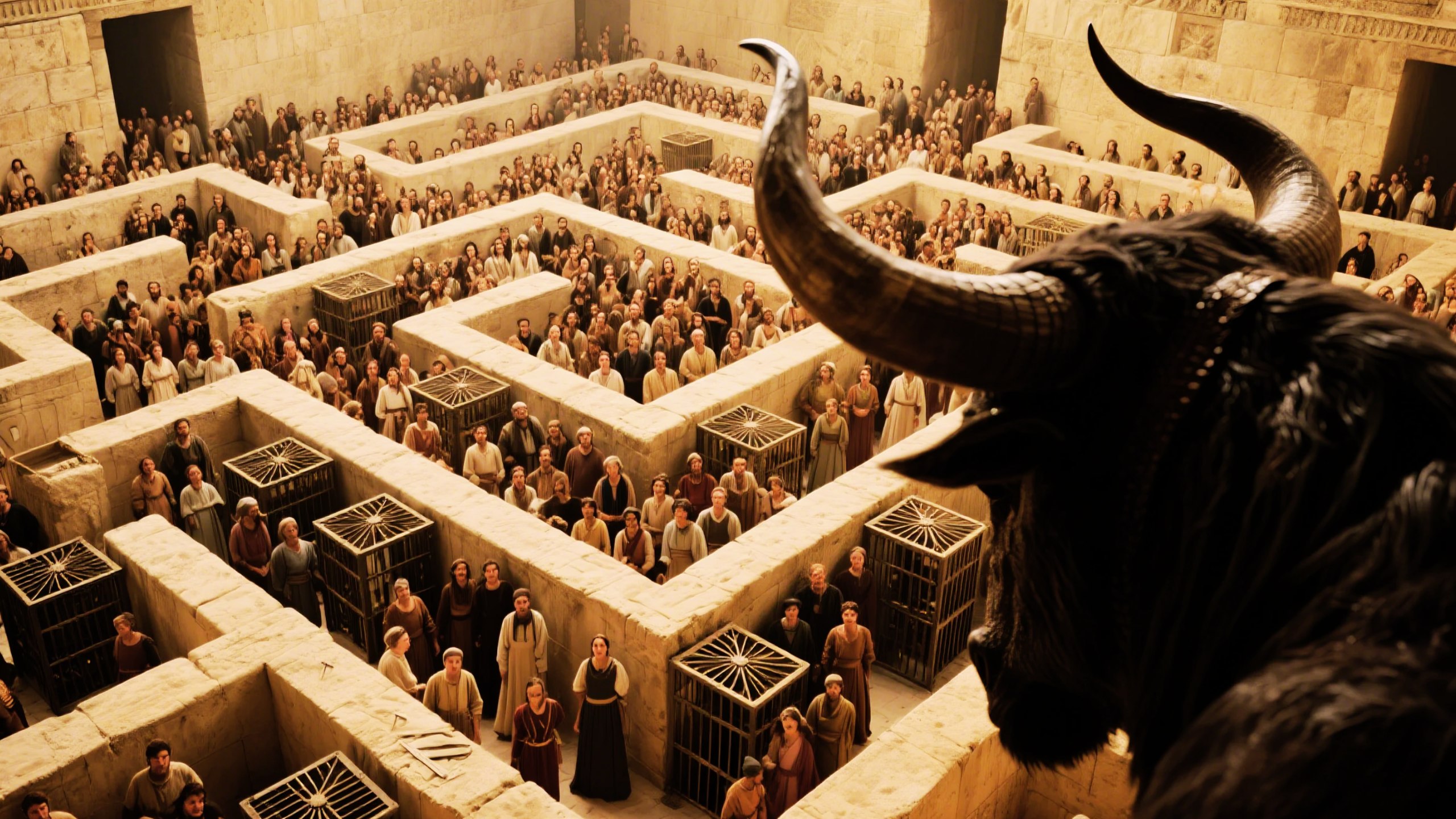
Prepare-se para uma história que vai fazer você questionar tudo o que sabia sobre os tempos antigos. Esqueça o que te contaram. Porque e se eu te dissesse que a lenda da criatura faminta, metade homem, metade fera, escondida num labirinto gigantesco em uma ilha muito antiga, não era bem sobre um monstro de chifres?

E se, na verdade, fosse a capa perfeita para esconder algo muito mais sombrio e cruel, uma máquina de terror montada por mãos humanas, que exigia vidas jovens e inocentes para manter um poder doentio e absoluto, num esquema tão complexo e assustador que faz a lenda do monstro parecer um conto de fadas infantil perto da verdade por trás dela?
Muito antes das histórias que conhecemos, existiu um lugar, uma ilha poderosa, cercada por um mar azul intenso, governada por figuras tão influentes que seu poder se estendia por terras distantes. Essa gente criou uma aura de controle e riqueza que encantava e amedrontava quem os conhecia. Mas por trás de toda a glória, da opulência dos seus templos e do domínio sobre os mares, pulsava um sistema de pavor absoluto. Para manter tudo isso em pé e garantir a lealdade dos povos subjugados, eles inventaram um terror que não podia ser visto, mas que sentia a cada vez que o mar trazia navios para recolher sua terrível “dízima”. A ideia era que, longe dos olhos, nos recônditos de um palácio que parecia um labirinto, uma criatura mítica exigia tributos humanos, um engodo assustador para desviar o olhar do verdadeiro horror que estava por trás.
Essas vítimas não eram pessoas capturadas ao acaso. Elas eram “escolhidas” – jovens vigorosos e inteligentes de outros reinos, dominados pela ilha, que eram forçados a enviá-los como um tipo de “presente” assustador e anual para o suposto monstro. Imagine o terror das famílias desses jovens! A cada ano, quando os mensageiros chegavam, um frio percorria a espinha de todos, sabendo que alguém teria que ir, uma vida teria que ser sacrificada em nome da paz forçada. As escolhas eram brutais e muitas vezes arbitrárias, servindo como uma demonstração de poder inquestionável: “Se não me obedecerem, seu povo será o próximo a alimentar a besta”. Os jovens eram levados em uma procissão silenciosa, sem esperança, o rosto pálido e os olhos arregalados, enquanto seus pais choravam em segredo, sem poder fazer absolutamente nada além de ver seus filhos partirem para nunca mais voltar. A despedida era o fim de suas vidas como as conheciam.
Uma vez na ilha central, esses jovens eram levados para o “Labirinto”. Não era um emaranhado de paredes qualquer, mas uma estrutura monumental e desorientadora que ia muito além de um simples prédio. Na verdade, tratava-se de um sistema complexo de corredores e câmaras dentro de um gigantesco palácio ou fortaleza, pensado para desorientar e prender quem entrava, um símbolo do poder absoluto e do caos controlado pelos líderes. Dentro dessa prisão de pedra, não havia um monstro literal. A “fera” era a crueldade dos rituais ali executados, a humilhação, os jogos sádicos e a lenta desumanização dos escolhidos. Em vez de serem devorados, esses jovens eram usados em desafios brutais, forçados a participar de espetáculos perigosos ou mesmo jogados em arenas subterrâneas contra feras treinadas, ou contra si próprios, servindo de diversão para a elite ou como uma macabra forma de extermínio que garantia que nenhum segredo escaparia, tudo sob a sombra da lenda para afastar a curiosidade dos plebeus.
O motivo por trás desse sistema bizarro e cruel era muito mais profundo do que simplesmente alimentar uma criatura imaginária. O verdadeiro propósito era a manutenção de um poder opressor. A “fome” do Minotauro era uma desculpa perfeita para eliminar potenciais rebeldes, rivais políticos ou mesmo para enriquecer através das propriedades dos “sacrificados”, que eram confiscadas. Ao impor um tributo tão horrível e sem sentido aparente, os governantes garantiam o medo e a submissão dos povos dominados. Ninguém se atreveria a questionar seu poder quando a alternativa era ter seus próprios filhos arrastados para o Labirinto. Além disso, a lenda servia para criar uma “purificação” social, afastando aqueles considerados “indesejáveis” ou “perigosos”, transformando-os em mártires de um mito. Era um sistema de terror psicológico perfeito, que fazia com que as próprias vítimas e suas comunidades participassem, mesmo que indiretamente, da manutenção do medo que os controlava.
As pessoas envolvidas nesse esquema eram muitas. No topo, é claro, estavam os governantes da ilha, o “Rei” e sua corte, que arquitetaram e supervisionaram toda a operação. Abaixo deles, sacerdotes ou conselheiros, figuras misteriosas que davam a aura “espiritual” e inevitável para os sacrifícios, manipulando o povo com profecias e rituais sombrios. Havia os guardiões e carrascos do Labirinto, homens brutais e leais que garantiam que os jovens não escapassem e que os horrores lá dentro permanecessem um segredo. Do outro lado, o povo comum – tanto o da ilha quanto o dos reinos dominados – vivia em um misto de medo paralisante, submissão resignada e um profundo terror silencioso. Eles se agarravam aos mitos para dar sentido ao inexplicável, esperando que o sacrifício de “outros” fosse suficiente para mantê-los seguros e preservar seus próprios filhos das garras da “fera”.
A reação do povo era um misto complexo de pavor, aceitação forçada e, por vezes, uma raiva impotente que precisava ser contida. Em muitos reinos dominados, a chegada dos navios era marcada por um luto silencioso. As famílias tentavam subornar ou esconder seus filhos, mas o medo das retaliações – que eram rápidas e brutais – geralmente os fazia ceder. A dor da perda era uma constante, mas falada apenas em sussurros. Acreditava-se que os deuses, ou a “fera”, precisavam ser aplacados, então, com o tempo, o sacrifício anual se tornou uma parte terrível da rotina, uma tradição macabra. Espiritualmente, isso criou uma religião de medo e submissão, onde a bondade divina era menos importante do que a evitação da fúria “do Minotauro”. O povo era ensinado a temer e a obedecer cegamente, pois a desobediência não levava apenas à morte, mas à total aniquilação simbólica da pessoa e sua família nas entranhas daquela estrutura infernal, cujos segredos ninguém que entrasse vivo saía para contar.
Pensando bem, essa história arrepiante não está tão distante da gente, não é? A gente não entrega jovens para uma criatura de chifres num labirinto de pedra, mas vivemos cercados por “monstros invisíveis” e “labirintos” que parecem engolir pessoas. Quantos de nós não sacrificamos horas da nossa vida, nossa saúde, nossa alegria, nossa paz de espírito em nome de “sistemas” que nos pedem mais e mais? Quantos de nós não estamos presos em “labirintos” de dívidas, expectativas sociais ou de empregos que nos desumanizam lentamente? As pressões sociais, o “cancelamento” em mídias digitais que parece um sacrifício público, ou o vício em consumo que nos aprisiona em ciclos sem fim – não são essas novas formas de “feras” que exigem nossos “tributos” em troca de uma falsa sensação de segurança ou aceitação? Pense em quantas vezes você se sentiu “preso” ou “consumido” por algo maior que você, algo que não consegue ver ou lutar de frente.

E aí, o que essa revelação te fez sentir? Chocado? Incrédulo? Me diga nos comentários se essa história te pegou de surpresa, se você já desconfiava de algo assim por trás das lendas, ou se ela te fez refletir sobre os labirintos e as “feras” da nossa própria vida. Compartilhe suas reações e opiniões, porque a sua voz é importante demais! Se essa viagem sombria ao passado te fascinou e te deixou com mais sede de mistérios, não perca tempo: deixe seu like nesse vídeo, inscreva-se no canal para não perder nada e ative o sininho das notificações! Tem muita coisa ainda mais chocante e fascinante da antiguidade esperando para ser revelada nos nossos próximos encontros!
Prepare yourself for a story that will make you question everything you knew about ancient times. Forget what you’ve been told. Because what if I told you that the legend of the hungry creature, half man, half beast, hidden in a gigantic labyrinth on a very ancient island, wasn’t really about a horned monster? What if, in fact, it was the perfect cover to hide something much darker and crueler, a machine of terror assembled by human hands, demanding young, innocent lives to maintain a sickening and absolute power, in a scheme so complex and terrifying that it makes the monster’s legend seem like a children’s fairy tale compared to the truth behind it?
Long before the stories we know, there existed a place, a powerful island, surrounded by an intense blue sea, ruled by figures so influential that their power extended to distant lands. These people created an aura of control and wealth that enchanted and frightened those who knew them. But behind all the glory, the opulence of their temples, and their dominion over the seas, pulsed a system of absolute dread. To maintain all this and ensure the loyalty of their subjugated peoples, they invented a terror that could not be seen, but which could be felt each time the sea brought ships to collect their terrible “tithe.” The idea was that, hidden from view, in the recesses of a palace that resembled a labyrinth, a mythical creature demanded human tributes, a frightening lure to divert attention from the true horror that lay behind.
These victims were not captured at random. They were “chosen”—vigorous, intelligent young men from other kingdoms, dominated by the island, who were forced to send them as a kind of frightening, annual “gift” to the supposed monster. Imagine the terror of these young men’s families! Each year, when the messengers arrived, a chill ran down everyone’s spine, knowing that someone would have to go, a life would have to be sacrificed in the name of forced peace. The choices were brutal and often arbitrary, serving as a demonstration of unquestionable power: “If you do not obey me, your people will be the next to feed the beast.” The young men were led away in a silent, hopeless procession, their faces pale and eyes wide, while their parents wept in secret, helpless to do anything but watch their children depart, never to return. The farewell was the end of their lives as they knew them.
Once on the central island, these young men were taken to the “Labyrinth.” It was no ordinary tangle of walls, but a monumental and disorienting structure that went far beyond a simple building. In fact, it was a complex system of corridors and chambers within a gigantic palace or fortress, designed to disorient and imprison those who entered, a symbol of absolute power and the chaos controlled by the leaders. Within this stone prison, there was no literal monster. The “beast” was the cruelty of the rituals performed there, the humiliation, the sadistic games, and the slow dehumanization of the chosen. Instead of being devoured, these young men were used in brutal challenges, forced to participate in dangerous spectacles, or even thrown into underground arenas against trained beasts, or against themselves, serving as entertainment for the elite or as a macabre form of extermination that ensured no secret would escape, all under the shadow of legend to ward off the curiosity of the commoners.
The motive behind this bizarre and cruel system was much deeper than simply feeding an imaginary creature. The true purpose was to maintain oppressive power. The Minotaur’s “hunger” was a perfect excuse to eliminate potential rebels, political rivals, or even to enrich themselves through the confiscation of the properties of the “sacrificed.” By imposing such a horrific and seemingly meaningless tribute, the rulers ensured the fear and submission of the dominated peoples. No one would dare question their power when the alternative was having their own children dragged into the Labyrinth. Furthermore, the legend served to create a social “purification,” removing those considered “undesirable” or “dangerous,” transforming them into martyrs of myth. It was a perfect system of psychological terror, which made the victims themselves and their communities participate, even if indirectly, in maintaining the fear that controlled them.
The people involved in this scheme were many. At the top, of course, were the island’s rulers, the “King” and his court, who masterminded and oversaw the entire operation. Below them were priests or advisors, mysterious figures who gave the sacrifices a “spiritual” and inevitable aura, manipulating the people with prophecies and dark rituals. There were the guardians and executioners of the Labyrinth, brutal and loyal men who ensured that the young did not escape and that the horrors within remained a secret. On the other side, the common people—both those of the island and those of the dominated kingdoms—lived in a mixture of paralyzing fear, resigned submission, and a profound, silent terror. They clung to myths to make sense of the inexplicable, hoping that the sacrifice of “others” would be enough to keep them safe and preserve their own children from the clutches of the “beast.”
The people’s reaction was a complex mix of dread, forced acceptance, and, at times, an impotent rage that needed to be contained. In many conquered kingdoms, the arrival of ships was marked by silent mourning. Families tried to bribe or hide their children, but fear of retaliation—which was swift and brutal—usually caused them to relent. The pain of loss was constant, but spoken of only in whispers. It was believed that the gods, or the “beast,” needed to be appeased, so over time, the annual sacrifice became a gruesome part of daily life, a macabre tradition. Spiritually, this created a religion of fear and submission, where divine goodness was less important than avoiding the wrath of the “Minotaur.” The people were taught to fear and obey blindly, for disobedience led not only to death but to the total symbolic annihilation of the person and their family within the bowels of that infernal structure, whose secrets no one who entered alive emerged to tell.
Come to think of it, this chilling story isn’t so far from us, is it? We don’t hand over young people to a horned creature in a stone labyrinth, but we live surrounded by “invisible monsters” and “mazes” that seem to swallow people. How many of us sacrifice hours of our lives, our health, our joy, our peace of mind in the name of “systems” that demand more and more of us? How many of us are trapped in “mazes” of debt, social expectations, or jobs that slowly dehumanize us? Social pressures, the “cancellation” on digital media that feels like a public sacrifice, or the consumer addiction that traps us in endless cycles—aren’t these new forms of “beasts” that demand our “tributes” in exchange for a false sense of security or acceptance? Think about how many times you’ve felt “trapped” or “consumed” by something bigger than yourself, something you can’t see or fight head-on.
So, how did this revelation make you feel? Shocked? Incredulous? Tell me in the comments if this story took you by surprise, if you already suspected something like this lurked behind the legends, or if it made you reflect on the labyrinths and “beasts” of our own lives. Share your reactions and opinions, because your voice is so important! If this dark journey into the past fascinated you and left you thirsting for more mysteries, don’t waste time: like this video, subscribe to the channel so you don’t miss anything, and turn on the notification bell! There’s even more shocking and fascinating things from antiquity waiting to be revealed in our next meetings!
Artigos Relacionados


Sobre o Autor

Sou Fabio Russo, desenvolvedor e administrador do site Artesanato Total desde 2015. A mais de 25 anos trabalho com diversos nichos de sites na Internet, sempre presando a qualidade em todos os projetos.
0 Comentários