As estranhas cabeças colossais olmecas: quem realmente foram esses gigantes?

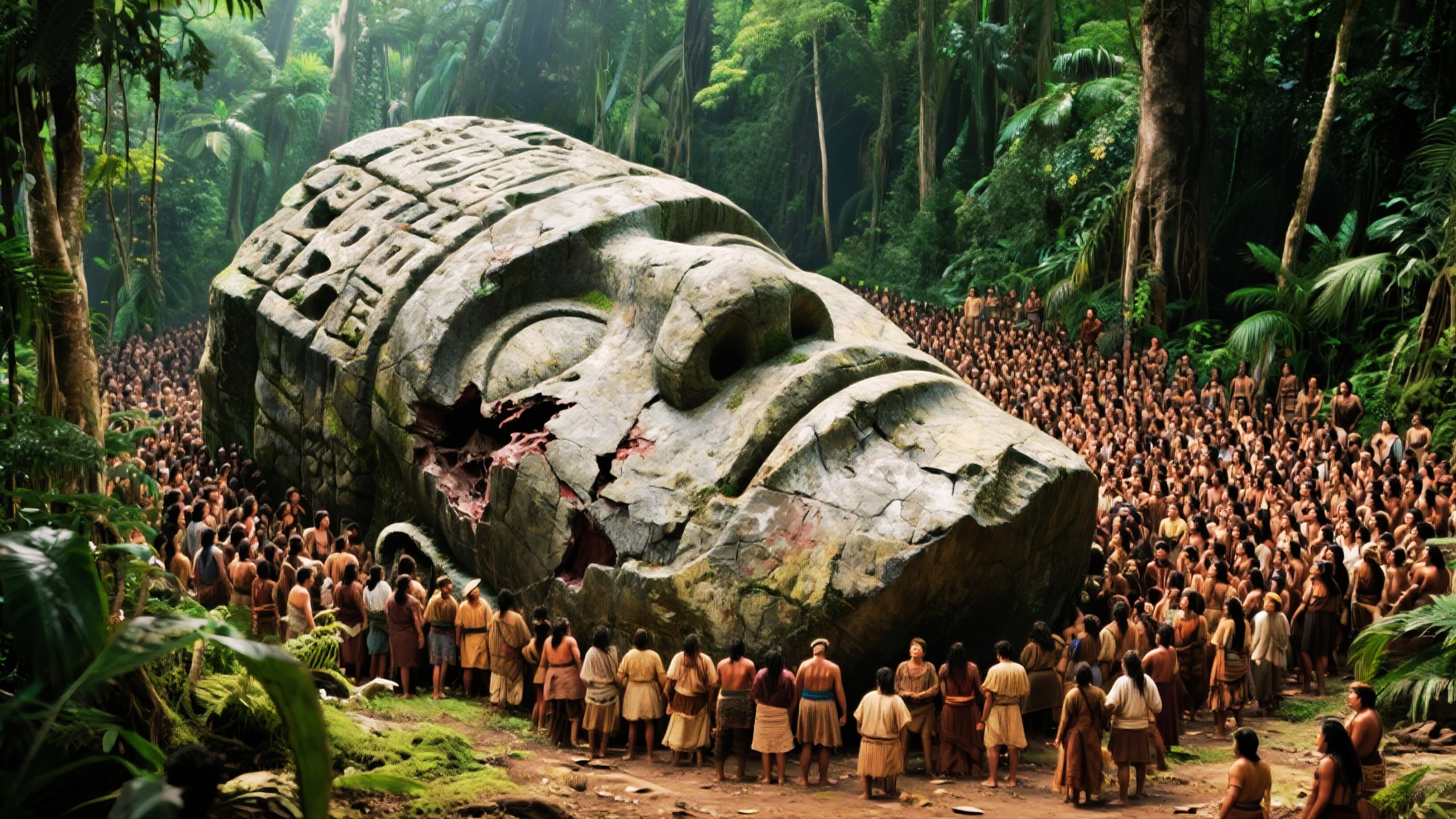
E se eu te contasse que existiu um povo antigo, mas muito antigo mesmo, que dominava técnicas tão incríveis que pareciam magia, e que essa galera simplesmente decidiu esculpir rostos gigantes de até 3 metros de altura, pesando mais de 20 toneladas, em pedras que vieram de bem longe, só para deixá-las olhando para o horizonte como se fossem guardiões de um segredo? Isso aconteceu de verdade e a história é ainda mais chocante!

Imagina o que é movimentar um bloco de pedra maior que um carro, vindo de uma pedreira a dezenas de quilômetros de distância, atravessando florestas densas, rios e pântanos sem a ajuda de nenhum tipo de tecnologia avançada, tipo guindastes ou caminhões. Pensa no suor, no sangue, nas lágrimas que cada uma dessas pedras brutas custou antes mesmo de ser tocada por uma ferramenta de escultura. A lenda é que esse povo não pensava duas vezes em usar o trabalho pesado de centenas, talvez milhares de pessoas para cada um desses projetos colossais. Elas amarravam essas rochas gigantes em toras de árvores robustas, usavam cordas de fibra vegetal grossas como braços e se revezavam em um balé de força bruta, empurrando, arrastando, levantando metro a metro. Era um sacrifício absurdo, uma jornada que podia levar meses ou até anos para cada peça, onde acidentes eram a norma e muitos não chegavam ao fim do caminho, esmagados pela própria obra que ajudavam a mover. Mas o medo e a fé, ou a devoção cega, os impulsionavam a seguir, a cumprir essa tarefa sobre-humana, pois acreditavam que estavam servindo a algo muito maior que eles mesmos. A verdade é que o custo humano para levantar uma dessas cabeças era algo que nos deixaria de boca aberta.
Quando o bloco chegava finalmente ao seu destino, o verdadeiro espetáculo de paciência e perícia começava: a escultura. Sem ferramentas de metal, sem martelos modernos ou cinzéis afiados, a arte dessas faces monumentais era criada a base de pedras mais duras que a rocha a ser trabalhada, martelando, raspando e lixando por um tempo que a gente nem consegue calcular. Centenas de artesãos especializados trabalhavam dia e noite, sob um sol escaldante ou na escuridão da floresta, guiados pela luz do fogo, por meses e anos, martelando sem parar. O barulho do impacto das pedras ressoava por quilômetros, um ritmo constante que parecia a pulsação do próprio solo, uma melodia sombria de devoção e esforço. Eram homens e mulheres, uma casta de artistas quase sacerdotais, que haviam dedicado suas vidas a esse ofício, com técnicas passadas de geração em geração, desde que eram pequenos aprendizes observando o pai ou a mãe modelarem o barro ou a pedra menor. Eles sabiam que um erro mínimo, uma lasca no lugar errado, poderia estragar meses de trabalho e, talvez, até custar suas próprias vidas, pois a punição para falhas tão grandes nessas sociedades costumava ser pesada.
E por que tanto sacrifício, tanta engenhosidade? Porque essas não eram apenas esculturas; elas eram manifestações de poder absoluto, retratos vivos de líderes ou talvez até de seres divinos que governavam aquele povo com mão de ferro e que tinham a palavra final sobre vida e morte. Imagina chegar em uma aldeia e dar de cara com um rosto de pedra gigante, com traços fortes, uma expressão serena e imponente, parecendo te observar de cima. Para o povo comum, essas cabeças eram uma prova irrefutável da autoridade dos seus chefes, ou dos seus deuses, ou dos dois. Era como se aqueles rostos dissessem: “Eu sou o poder aqui. Eu sou a lei. Eu sou o guardião de vocês.” Era um recado visível, gigante e inegável, para quem quisesse desafiar a ordem. A presença dessas faces enormes nas entradas das cidades ou em praças principais era uma maneira de marcar território, de anunciar a grandeza e a força dessa civilização, deixando qualquer um que chegasse sabendo exatamente quem mandava por ali.
A lenda fala que a escolha do local para retirar essas pedras não era à toa. Era como se a montanha guardasse a alma desses gigantes, e que a extração da pedra era um ritual de “nascimento”. As pedreiras não eram apenas um lugar para encontrar rochas, mas sim lugares sagrados, envoltos em misticismo, onde rituais complexos eram realizados antes, durante e depois da retirada de cada bloco maciço. Sacerdotes e líderes religiosos daquela época conduziam essas cerimônias, oferendas eram feitas aos deuses das montanhas e rios, talvez até sacrifícios mais extremos para acalmar os espíritos da terra e garantir uma viagem segura para a pedra sagrada. Os envolvidos na remoção não eram apenas trabalhadores, mas participantes de um rito de passagem, uma peregrinação perigosa, cheia de mistério e temor. O percurso da pedreira até a cidade era visto como a “jornada do gigante”, e cada etapa era marcada por ritos, cantos e orações, pois a falha não era apenas um desastre material, mas uma afronta aos deuses, um sinal de que algo estava terrivelmente errado com o destino ou a liderança da comunidade.
O momento da instalação de uma cabeça colossal devia ser algo inacreditável para quem presenciava. Não era apenas empurrar uma pedra para um buraco; era uma festa solene, uma demonstração de poder religioso e político que mobilizava toda a comunidade. Imagina centenas de pessoas puxando, girando e lentamente, milímetro por milímetro, colocando a escultura no lugar perfeito, com a ajuda de rampas de terra batida e toras rolantes. O ar ficava pesado com a fumaça de incensos, o som de tambores batendo num ritmo hipnótico e o canto de orações se espalhavam pelo ar. Para o povo comum, ver uma dessas cabeças erguida era uma experiência espiritual profunda. Não era só um rosto; era a presença dos ancestrais, a vigilância dos deuses, a garantia de colheitas abundantes e a proteção contra inimigos e calamidades. E o choque, o espanto, o reverência absoluta estampavam os rostos de todos. Eles sentiam que faziam parte de algo grandioso, um legado eterno construído por suas próprias mãos e fé, que os unia de uma forma indissolúvel a essa potência.
E como é que uma civilização que conseguiu levantar esses monumentos espetaculares desapareceu sem deixar tantos rastros além das cabeças? As histórias desse povo misterioso contam que nem todos os fins são felizes, e até as mais poderosas civilizações podem ter seus pontos finais. E o mais chocante é que algumas dessas cabeças foram encontradas deformadas, com pedaços quebrados, desfiguradas ou até mesmo enterradas de propósito, como se alguém quisesse apagar sua existência. Por que fariam isso? Uma das narrativas mais perturbadoras é a de que um dia, algo drástico aconteceu. Talvez invasores brutais que queriam destruir qualquer símbolo da civilização que dominavam, ou uma revolta interna, onde o próprio povo, exausto pela tirania e pelos sacrifícios exigidos, virou suas costas contra seus próprios deuses e líderes, destruindo tudo que representava essa ordem. As cabeças, que um dia inspiraram reverência, foram viradas de ponta-cabeça, quebradas, mutiladas e jogadas na lama, simbolizando o fim de uma era, uma mensagem brutal de vingança ou de um esquecimento forçado. O simples fato de terem a capacidade de destruir algo que exigiu tanto esforço para ser criado é um testamento do nível de desespero ou revolta que podia tomar conta de um povo.
Por trás de cada cinzelada, cada martelada e cada centímetro que uma pedra dessas era movida, havia uma sociedade com sua própria hierarquia de artistas, engenheiros e “mestres das pedras” que guardavam segredos profundos. Essas pessoas não eram meros artesãos; eram uma espécie de elite, talvez sacerdotes-artesãos, que detinham um conhecimento imenso sobre as rochas, sobre os caminhos, e que tinham o poder de fazer essas imagens saírem da pedra bruta. Imagina essa sociedade secreta, um grupo exclusivo, cujo conhecimento era tão sagrado que era passado apenas de boca em boca, de mestre para discípulo, em rituais isolados e com juramentos de silêncio absolutos. Eram os guardiões de uma tecnologia tão avançada para sua época que, para o povo, parecia bruxaria. A vida de cada um desses escultores de elite era totalmente dedicada à sua arte e à sua fé, e o respeito por eles era imenso. Sua visão era a lei, e o produto de suas mãos, o destino que marcava a força e a permanência de uma civilização que hoje é um dos maiores mistérios de um tempo que já se foi.
Quando a gente pensa nesses feitos impressionantes e até chocantes de uma cultura tão antiga, parece que estamos falando de algo muito distante. Mas para e pensa: no nosso dia a dia, mesmo sem escravos ou ferramentas de pedra, a gente não move “montanhas” para conquistar coisas que parecem impossíveis? Quantos de nós sacrificamos nosso tempo, nosso dinheiro, nossa energia para construir coisas gigantescas — sejam arranha-céus, empresas enormes, ou até a carreira dos nossos sonhos — que no fim das contas, de alguma forma, também são monumentos ao nosso poder, à nossa ambição ou aos nossos ideais? E não tememos o fracasso ou a perda tanto quanto um artesão daquela época temia um erro? A busca por reconhecimento, por deixar uma marca que diga “eu estive aqui”, por impor uma visão ao mundo, não é um impulso tão antigo quanto as próprias cabeças gigantes que nos intrigam até hoje? A escala mudou, as ferramentas também, mas a essência do ser humano em criar, controlar e deixar um legado, mesmo que colossal, permanece a mesma.

E aí, o que você sentiu ao descobrir esses mistérios e essa história por trás das cabeças colossais desse povo impressionante? Deu para sentir um frio na barriga pensando em todo o sacrifício e no mistério que cerca essas esculturas? Eu quero muito saber o que você achou, quais foram suas primeiras reações, se você já conhecia algo parecido ou se essa história te deixou de queixo caído. Deixa seu comentário aqui embaixo e vamos trocar uma ideia sobre esse tema fascinante! E se você gostou desse mergulho no passado, não se esqueça de deixar o seu like, se inscrever no canal e ativar o sino das notificações. Assim você não perde os próximos vídeos, onde vamos continuar desvendando muitos outros segredos chocantes e histórias inacreditáveis da antiguidade que prometem te deixar fascinado! Valeu, e até a próxima!
What if I told you there was an ancient people, a truly ancient people, who mastered techniques so incredible they seemed like magic, and that these people simply decided to carve giant faces up to 3 meters tall, weighing over 20 tons, into stones brought from far away, just to leave them staring into the horizon as if they were guardians of a secret? This really happened, and the story is even more shocking!
Imagine moving a block of stone larger than a car, coming from a quarry dozens of kilometers away, crossing dense forests, rivers, and swamps without the help of any kind of advanced technology, like cranes or trucks. Think of the sweat, blood, and tears each of these rough stones cost before even being touched by a sculpting tool. Legend has it that these people didn’t think twice about using the hard labor of hundreds, perhaps thousands of people for each of these colossal projects. They tied these giant rocks to sturdy tree trunks, using thick plant fiber ropes as arms, and took turns in a ballet of brute strength, pushing, dragging, and lifting meter by meter. It was an absurd sacrifice, a journey that could take months or even years for each piece, where accidents were the norm, and many never reached the end of the journey, crushed by the very work they helped move. But fear and faith, or blind devotion, drove them on, to accomplish this superhuman task, for they believed they were serving something much greater than themselves. The truth is, the human cost of lifting one of these heads was something that would leave us speechless.
When the block finally reached its destination, the true spectacle of patience and skill began: the carving. Without metal tools, modern hammers, or sharp chisels, the art of these monumental faces was created using stones harder than the rock being worked, hammering, scraping, and sanding for an incalculable amount of time. Hundreds of skilled artisans worked day and night, under a scorching sun or in the darkness of the forest, guided by firelight, for months and years, hammering tirelessly. The sound of the impact of the stones echoed for miles, a constant rhythm that sounded like the pulse of the ground itself, a somber melody of devotion and effort. They were men and women, a caste of almost priestly artists, who had dedicated their lives to this craft, using techniques passed down from generation to generation, ever since they were young apprentices watching their father or mother shape clay or the smallest stone. They knew that a tiny mistake, a chip in the wrong place, could ruin months of work and perhaps even cost them their lives, for the punishment for such major failures in these societies was often severe.
And why so much sacrifice, so much ingenuity? Because these were not just sculptures; they were manifestations of absolute power, living portraits of leaders or perhaps even divine beings who ruled these people with an iron fist and who held the final say over life and death. Imagine arriving in a village and coming face to face with a giant stone face, with strong features and a serene and imposing expression, seemingly watching you from above. For the common people, these heads were irrefutable proof of the authority of their chiefs, or their gods, or both. It was as if those faces were saying: “I am the power here. I am the law. I am your guardian.” It was a visible, gigantic, and undeniable message to anyone who might challenge the order. The presence of these enormous faces at the entrances to cities or in main squares was a way of marking territory, of announcing the greatness and strength of this civilization, letting anyone who arrived know exactly who was in charge.
Legend has it that the choice of location for extracting these stones was no accident. It was as if the mountain held the souls of these giants, and that the extraction of the stone was a ritual of “birth.” Quarries were not just a place to find rocks, but sacred places, shrouded in mysticism, where complex rituals were performed before, during, and after the removal of each massive block. Priests and religious leaders of the time conducted these ceremonies, offerings were made to the gods of the mountains and rivers, perhaps even more extreme sacrifices to appease the spirits of the earth and ensure a safe journey for the sacred stone. Those involved in the removal were not just workers, but participants in a rite of passage, a perilous pilgrimage, full of mystery and fear. The journey from the quarry to the city was seen as the “giant’s journey,” and each stage was marked by rites, chants, and prayers, for failure was not just a material disaster, but an affront to the gods, a sign that something was terribly wrong with the destiny or the leadership of the community.
The moment a colossal head was installed must have been incredible for those who witnessed it. It wasn’t just pushing a stone into a hole; it was a solemn celebration, a demonstration of religious and political power that mobilized the entire community. Imagine hundreds of people pulling, turning, and slowly, millimeter by millimeter, placing the sculpture in the perfect spot, with the help of rammed earth ramps and rolling logs. The air was heavy with the smoke of incense, the sound of drums beating in a hypnotic rhythm, and the chanting of prayers filled the air. For the common people, seeing one of these heads erected was a profound spiritual experience. It wasn’t just a face; it was the presence of ancestors, the watchfulness of the gods, the guarantee of abundant harvests and protection from enemies and calamities. And shock, amazement, and absolute reverence were etched on everyone’s faces. They felt they were part of something grand, an eternal legacy built by their own hands and faith, which bound them inextricably to this power.
And how did a civilization that managed to erect such spectacular monuments disappear without leaving so many traces beyond the heads? The stories of this mysterious people tell us that not all endings are happy, and even the most powerful civilizations can have their final moments. And the most shocking thing is that some of these heads were found deformed, with broken pieces, disfigured, or even buried on purpose, as if someone wanted to erase their existence. Why would they do this? One of the most disturbing narratives is that one day, something drastic happened. Perhaps brutal invaders who wanted to destroy any symbol of the civilization they dominated, or an internal revolt, where the people themselves, exhausted by tyranny and the sacrifices demanded, turned their backs on their own gods and leaders, destroying everything that represented that order. The heads, which once inspired reverence, were turned upside down, broken, mutilated, and thrown into the mud, symbolizing the end of an era, a brutal message of revenge or forced oblivion. The mere fact that they had the ability to destroy something that took so much effort to create is a testament to the level of desperation or revolt that could grip a people.
Behind every chiseled stroke, every hammer blow, and every inch that such a stone was moved, there was a society with its own hierarchy of artists, engineers, and “stone masters” who guarded profound secrets. These people were not mere artisans; they were a kind of elite, perhaps artisan-priests, who held immense knowledge of the rocks, of the paths, and who had the power to create these images from the rough stone. Imagine this secret society, an exclusive group, whose knowledge was so sacred that it was passed down only by word of mouth, from master to disciple, in secluded rituals and with oaths of absolute silence. They were the guardians of a technology so advanced for their time that, to the people, it seemed like witchcraft. The life of each of these elite sculptors was completely dedicated to their art and their faith, and the respect for them was immense. His vision was the law, and the product of his hands, the destiny that marked the strength and permanence of a civilization that today is one of the greatest mysteries of a time that has already passed.
When we think about these impressive, even shocking, feats of such an ancient culture, it seems like we’re talking about something very distant. But stop and think: in our daily lives, even without slaves or stone tools, don’t we move “mountains” to achieve things that seem impossible? How many of us sacrifice our time, our money, our energy to build gigantic things—be they skyscrapers, enormous companies, or even our dream careers—that ultimately, in some way, are also monuments to our power, our ambition, or our ideals? And don’t we fear failure or loss as much as a craftsman of that era feared a mistake? Isn’t the quest for recognition, for leaving a mark that says “I was here,” for imposing a vision on the world, an impulse as old as the giant heads that intrigue us to this day? The scale has changed, the tools too, but the human essence of creating, controlling, and leaving a legacy, however colossal, remains the same.
So, what did you feel when you discovered these mysteries and the story behind the colossal heads of these impressive people? Did you get butterflies in your stomach thinking about all the sacrifice and mystery surrounding these sculptures? I’d love to hear what you thought, what your initial reactions were, whether you’ve already heard something similar, or if this story left you speechless. Leave your comment below and let’s discuss this fascinating topic! And if you enjoyed this dive into the past, don’t forget to like, subscribe to the channel, and hit the notification bell. That way, you won’t miss the next videos, where we’ll continue to uncover many more shocking secrets and unbelievable stories from antiquity that promise to leave you spellbound! Thanks, and until next time!
Artigos Relacionados


Sobre o Autor

Sou Fabio Russo, desenvolvedor e administrador do site Artesanato Total desde 2015. A mais de 25 anos trabalho com diversos nichos de sites na Internet, sempre presando a qualidade em todos os projetos.
0 Comentários