Padre deixa hóstia cair durante comunhão e algo inacreditável é encontrado nela – Milagre Eucarístico de Legnica na Polôni

Você já parou para pensar se, em um mundo tão racional e científico como o nosso, Deus ainda se manifesta de formas que a própria ciência tem dificuldade de explicar? E se eu te dissesse que, em pleno século XXI, na Europa, um evento aconteceu que desafiou a lógica e apontou diretamente para a fé que muitos de nós professamos, um sinal visível da presença divina entre nós?

Prepare-se para ouvir uma história real, confirmada pela ciência e reconhecida pela Igreja, que aconteceu na Polônia e pode transformar a sua maneira de ver a Eucaristia e a ação de Deus no mundo. Mas antes de mergulharmos fundo nesse relato inspirador, há algo que podemos fazer juntos AGORA MESMO. Falando em fé e na força da oração, se você tem alguém em sua vida – um filho, um pai, um amigo, um parente – que está passando por um momento difícil, que precisa de cura, de esperança, de paz, ou de conversão, deixe o nome dele ou dela escrito nos comentários AGORA. Iremos recolher todos esses nomes e incluí-los em nossa oração principal com o Rosário, clamando a intercessão divina por eles. E, se você sente que este trabalho, que busca levar esperança e fé através dessas histórias, considere fazer uma doação. O valor que vier do seu coração, por menor que seja, fará uma enorme diferença para a manutenção e crescimento do canal. É simples e rápido, basta clicar no primeiro link na descrição deste vídeo ou no botão “Thanks” (ou “Valeu”) que aparece abaixo. Agradecemos de coração sua generosidade.
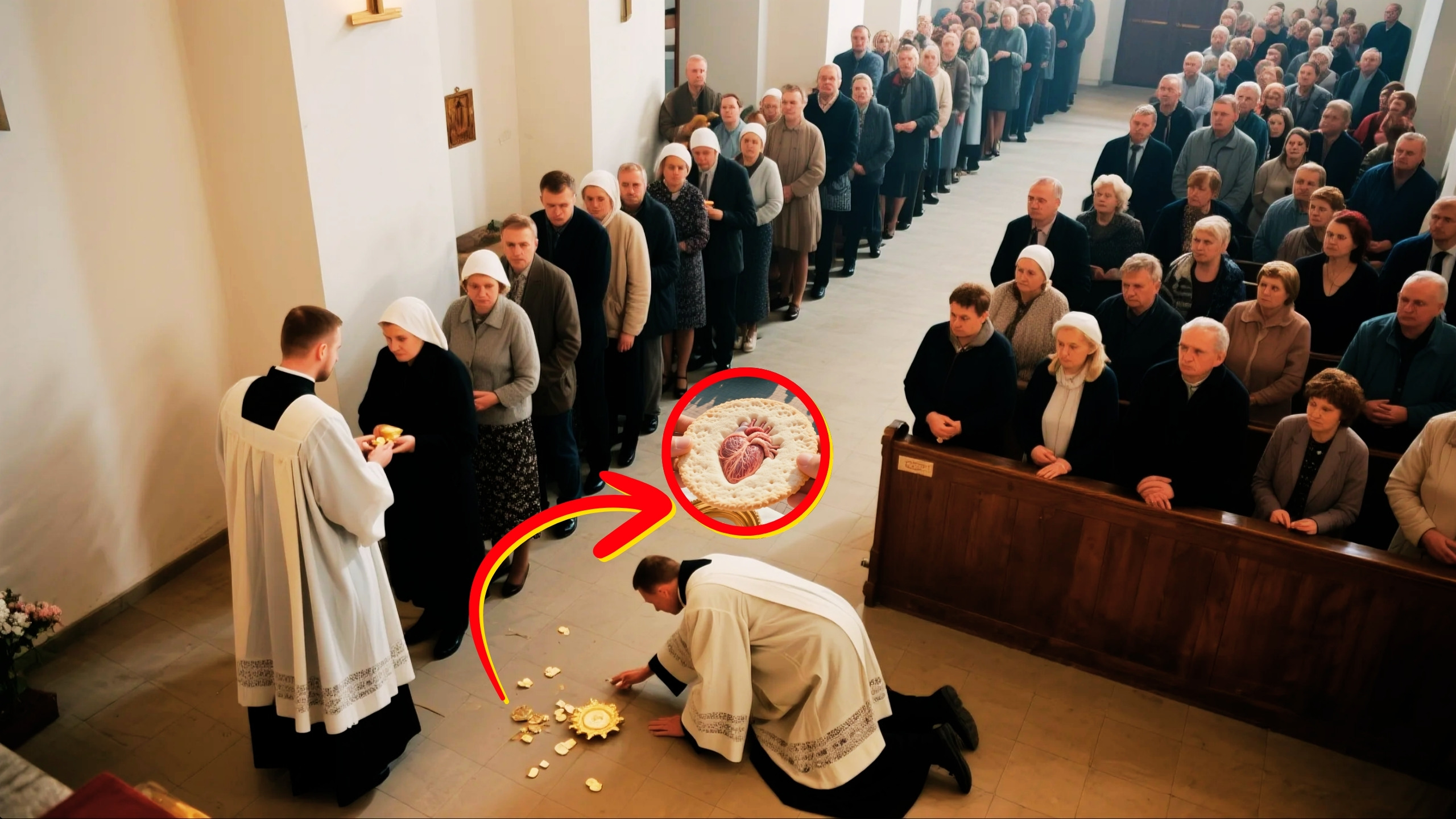
Nossa história começa em um lugar que para muitos parece distante, a pequena e histórica cidade de Legnica, na Polônia, em um dia aparentemente comum de Natal, no ano de 2013. Era mais uma celebração da Eucaristia na igreja paroquial de Santo Jacó Apóstolo, um momento sagrado para a comunidade, onde os fiéis se reúnem para receber o Corpo e o Sangue de Cristo, a parte central da fé católica. Durante a distribuição da Comunhão, como pode acontecer em qualquer Missa, algo inesperado aconteceu, algo que, à primeira vista, poderia parecer apenas um pequeno acidente: uma hóstia consagrada, o pão que se tornou, pela fé, o Corpo de Cristo, caiu ao chão. Este momento, por si só, já exige reverência e cuidado, pois para os católicos, ali está a Presença Real de Jesus. Seguindo as normas litúrgicas da Igreja, o sacerdote que administrava a Comunhão agiu prontamente: a hóstia caída foi cuidadosamente recolhida com o respeito que lhe era devido e, conforme o protocolo estabelecido para esses casos, foi colocada em um pequeno recipiente com água, que seria guardado no sacrário para que a hóstia se dissolvesse completamente antes de ser descartada de maneira apropriada e reverente, garantindo assim que nenhuma partícula do Corpo de Cristo fosse profanada. O que parecia um simples acidente, contudo, estava prestes a se tornar o prelúdio de um acontecimento extraordinário que ecoaria pelo mundo.
Nos dias que se seguiram, enquanto a hóstia repousava no recipiente com água, esperando a dissolução natural que sempre ocorre, algo absolutamente inesperado e inexplicável começou a acontecer. Em vez de se desfazer lentamente e desaparecer na água, a hóstia parecia estar passando por uma transformação singular. Observou-se o surgimento de uma mancha vermelha intensa e visível, que não se espalhava ou se diluía como seria esperado de um corante ou de algo inorgânico. Esta mancha começou a se solidificar, formando o que parecia ser um tecido, com fibras e textura, distinto da fragilidade original do pão. Não era uma simples mudança de cor; era uma alteração física na estrutura da hóstia, algo que desafiava completamente o processo normal de dissolução em água. A notícia dessa observação incomum e intrigante chegou aos ouvidos do então pároco e, posteriormente, do Bispo de Legnica, Dom Zbigniew Kiernikowski. Diante da seriedade do acontecimento e da possibilidade de se tratar de algo de origem divina, a Igreja local, agindo com a prudência e o rigor que a tradição exige em casos de possíveis fenômenos sobrenaturais, decidiu que esse material incomum precisava ser investigado a fundo, e não apenas com base na fé, mas também com a ajuda da ciência.
Cientes da profunda implicação de tal fenômeno, o Bispo Dom Zbigniew Kiernikowski agiu com extrema cautela e seguindo as diretrizes estabelecidas pela Congregação para a Doutrina da Fé no Vaticano para o discernimento de supostos milagres eucarísticos. Não se tratava apenas de observar e crer, mas de submeter o acontecimento a um exame rigoroso e imparcial. O material, que havia se formado na hóstia e parecia tecido, foi cuidadosamente retirado do recipiente e preparado para análise científica. O primeiro passo foi enviar a amostra para laboratórios de patologia forense de renome na Polônia, onde cientistas e médicos, usando os métodos mais avançados disponíveis, pudessem determinar a natureza exata desse material. O objetivo era eliminar qualquer possibilidade de ser algo mundane, como um contaminante, um fungo, um pigmento ou qualquer outra explicação natural. Foram realizadas análises em diferentes instituições científicas respeitadas, incluindo institutos em Wrocław e posteriormente em Szczecin, garantindo assim múltiplos exames e uma análise cruzada dos resultados. A Igreja buscou a ciência para entender o que a razão humana poderia explicar, antes de considerar a possibilidade de algo que transcende a explicação natural.

Os resultados das análises científicas, realizados por patologistas independentes e especializados, foram absolutamente surpreendentes e, para muitos, chocantes. Os laudos confirmaram que o tecido analisado era, de fato, de origem humana. Mas não era qualquer tecido; as análises microscópicas e genéticas indicaram que se tratava especificamente de tecido muscular cardíaco, ou seja, tecido do músculo do coração. E os detalhes encontrados foram ainda mais impressionantes e comoventes: os estudos indicaram que o tecido miocárdico apresentava características de estar sob grande estresse, com alterações que seriam observadas em um músculo cardíaco que sofreu, como em um momento de intenso sofrimento. Cientificamente, era tecido cardíaco humano, e as evidências apontavam para um estado de sofrimento. Para a comunidade científica, a presença de tecido humano, especialmente tecido cardíaco, em uma hóstia de pão de trigo que havia caído e sido colocada em água, era algo completamente inexplicável pelas leis naturais da física e da biologia. Para os fiéis, este achado ressoava profundamente com a fé na Presença Real de Jesus na Eucaristia e com a narrativa de Sua Paixão e Morte, onde Ele sofreu imensamente por amor à humanidade. A ciência havia encontrado algo que apontava diretamente para o cerne da fé.
Com os resultados científicos em mãos, que eliminavam as explicações naturais, a Igreja em Legnica iniciou a fase final e crucial do discernimento. O Bispo Dom Zbigniew Kiernikowski não se apressou; ele formou uma comissão teológica para estudar os laudos científicos à luz da fé e da tradição da Igreja. Este processo envolveu oração, estudo aprofundado, consulta a especialistas em diversas áreas e uma avaliação cuidadosa de todos os aspectos do evento, incluindo seu impacto espiritual na comunidade. A Igreja Católica, ao longo de sua história, sempre foi cautelosa ao reconhecer milagres, exigindo evidências sólidas e um processo rigoroso para evitar enganos ou sugestões. Não se trata apenas de um fenômeno inexplicável, mas de um sinal que aponta para Deus e fortalece a fé. Após um período de investigação detalhada e discernimento, que durou mais de dois anos após a conclusão das análises científicas, o Bispo de Legnica chegou a uma conclusão. Em abril de 2016, ele emitiu um comunicado oficial declarando que, após considerar os resultados das análises e o parecer da comissão teológica, o evento ocorrido em Legnica “tem as características de um milagre eucarístico”. Esta foi a declaração formal da Igreja, reconhecendo a intervenção divina naquele acontecimento.
O reconhecimento do Milagre Eucarístico de Legnica pela Igreja Católica ressoou em toda a Polônia e pelo mundo, tornando-se rapidamente um local de peregrinação e um poderoso testemunho da fé na Presença Real de Jesus na Eucaristia. Em um tempo em que muitas pessoas questionam ou se afastam da fé, e onde a própria doutrina da Transubstanciação – a crença de que o pão e o vinho se tornam o Corpo e o Sangue de Cristo durante a Missa – pode ser vista como algo simbólico ou abstrato, este milagre serviu como um sinal concreto e visível. Ele nos lembra que a Eucaristia não é apenas um símbolo, mas o próprio Jesus, que se oferece a nós de forma real e presente. Para muitos fiéis, a possibilidade de ver e venerar a hóstia que manifestou esse tecido cardíaco humano sob estresse é uma experiência profundamente comovente, que fortalece a fé e reacende o fervor na participação da Missa e na recepção da Comunhão. É como se o próprio Deus, em Sua infinita bondade e paciência, nos oferecesse uma prova tangível, um lembrete de Seu amor e sacrifício por nós, presente de forma humilde no pão consagrado. O Milagre de Legnica nos convida a olhar para o altar com reverência renovada e a compreender a profundidade do mistério que celebramos.
A história do Milagre da Polônia, com sua combinação surpreendente de fé e ciência, nos convida a olhar para a nossa própria fé e para o nosso dia a dia. Assim como a hóstia aparentemente comum se transformou, nossas vidas também são chamadas à transformação pela graça de Deus. Este milagre nos lembra que a presença de Deus não está confinada a eventos extraordinários ou a lugares distantes; Ele está presente em nosso cotidiano, nos esperando na oração, no serviço ao próximo, nos sacramentos, e especialmente na Eucaristia que recebemos. Ele nos inspira a buscar uma vida de fé mais autêntica e profunda, que se manifesta em ações concretas: em perdoar genuinamente aqueles que nos magoaram, liberando os fardos do ressentimento para encontrar a paz interior que só Deus pode dar; em ter a coragem de dar testemunho da nossa fé, não com palavras vazias, mas com uma vida que reflete o amor de Cristo; em buscar a conversão diária, afastando-nos do pecado e aproximando-nos da santidade; e, acima de tudo, em cultivar uma fé inabalável, que nos sustenta nas tribulações e nos impulsiona na alegria. E é nesse caminho de fé diária, onde encontramos tantos desafios e pessoas amadas que precisam de ajuda divina, que reitero nosso convite especial. Deixe agora mesmo nos comentários os nomes das pessoas por quem você quer que oremos, que precisam de um toque de Deus em suas vidas. Incluiremos todos esses nomes em nossa oração principal com o Rosário, confiando na poderosa intercessão de Maria e na misericórdia de Jesus.
O Milagre Eucarístico de Legnica, na Polônia, é mais do que apenas uma história fascinante; é um lembrete poderoso da presença contínua de Deus em nosso mundo e um chamado a renovar nossa fé na Eucaristia, o coração da vida cristã. É um convite para acreditar que Deus ainda opera milagres, grandes ou pequenos, na vida de quem confia Nele. E agora, eu quero muito saber a sua opinião sincera sobre este milagre. O que esta história significa para você? Ela fortalece sua fé? Você já tinha ouvido falar dela? Compartilhe seus pensamentos e sentimentos nos comentários abaixo; sua participação enriquece muito nosso espaço e nossa comunidade. Se esta história tocou seu coração, te inspirou ou agregou valor à sua caminhada de fé, por favor, não se esqueça de deixar o seu like neste vídeo para que o YouTube o mostre para mais pessoas que precisam ouvir esta mensagem de esperança. Compartilhe este vídeo com seus amigos e familiares que possam se interessar por histórias como essa. E, se você ainda não faz parte da nossa comunidade de fé aqui no YouTube, se inscreva no canal e ative o sininho das notificações para não perder nenhum dos nossos próximos vídeos e conteúdos inspiradores. Muito obrigado por sua presença, por sua oração e por seu apoio. Que Deus abençoe você e toda a sua família com paz, saúde e muita fé. Fiquem com Deus e até o próximo vídeo!
Have you ever stopped to think whether, in a world as rational and scientific as ours, God still manifests himself in ways that science itself has difficulty explaining? What if I told you that, in the 21st century, in Europe, an event took place that defied logic and pointed directly to the faith that many of us profess, a visible sign of the divine presence among us? Get ready to hear a true story, confirmed by science and recognized by the Church, that happened in Poland and can transform the way you see the Eucharist and God’s action in the world. But before we dive deep into this inspiring story, there is something we can do together RIGHT NOW. Speaking of faith and the power of prayer, if you have someone in your life – a child, a parent, a friend, a relative – who is going through a difficult time, who needs healing, hope, peace, or conversion, leave his or her name written in the comments NOW. We will collect all of these names and include them in our main prayer with the Rosary, asking for divine intercession for them. And if you feel that this work, which seeks to bring hope and faith through these stories, please consider making a donation. Any amount that comes from your heart, no matter how small, will make a huge difference in maintaining and growing the channel. It’s quick and easy, just click on the first link in the description of this video or on the “Thanks” button below. We sincerely appreciate your generosity.
Our story begins in a place that seems far away to many, the small and historic city of Legnica, in Poland, on a seemingly ordinary Christmas day in 2013. It was just another celebration of the Eucharist in the parish church of St. Jacob the Apostle, a sacred moment for the community, where the faithful gather to receive the Body and Blood of Christ, the central part of the Catholic faith. During the distribution of Communion, as can happen at any Mass, something unexpected happened, something that, at first glance, might seem like just a minor accident: a consecrated host, the bread that became, through faith, the Body of Christ, fell to the floor. This moment, in itself, demands reverence and care, because for Catholics, it is the Real Presence of Jesus. Following the liturgical norms of the Church, the priest administering Communion acted promptly: the fallen host was carefully collected with the respect that was due to it and, according to the protocol established for such cases, it was placed in a small container with water, which would be kept in the tabernacle so that the host would dissolve completely before being discarded in an appropriate and reverent manner, thus ensuring that not a single particle of the Body of Christ would be desecrated. What seemed like a simple accident, however, was about to become the prelude to an extraordinary event that would echo throughout the world.
In the days that followed, as the host sat in the container of water, waiting for the natural dissolution that always occurs, something completely unexpected and inexplicable began to happen. Instead of slowly dissolving and disappearing into the water, the host seemed to undergo a singular transformation. A bright red stain was observed to appear, visible and not spreading or diluting as would be expected from a dye or something inorganic. This stain began to solidify, forming what appeared to be a tissue, with fibers and texture, distinct from the original fragility of the bread. This was not a simple change in color; it was a physical alteration in the structure of the host, something that completely defied the normal process of dissolution in water. News of this unusual and intriguing observation reached the ears of the then parish priest and later Bishop of Legnica, Zbigniew Kiernikowski. Given the seriousness of the event and the possibility that it was something of divine origin, the local Church, acting with the prudence and rigor that tradition demands in cases of possible supernatural phenomena, decided that this unusual material needed to be investigated in depth, and not only based on faith, but also with the help of science.
Aware of the profound implications of such a phenomenon, Bishop Zbigniew Kiernikowski acted with extreme caution and in accordance with the guidelines established by the Vatican’s Congregation for the Doctrine of the Faith for the discernment of alleged Eucharistic miracles. It was not just a matter of observation and belief, but of subjecting the event to rigorous and impartial examination. The material, which had formed on the host and looked like tissue, was carefully removed from the container and prepared for scientific analysis. The first step was to send the sample to renowned forensic pathology laboratories in Poland, where scientists and physicians, using the most advanced methods available, could determine the exact nature of the material. The aim was to eliminate any possibility that it was something mundane, such as a contaminant, a fungus, a pigment or any other natural explanation. Analyses were carried out at several respected scientific institutions, including institutes in Wrocław and later in Szczecin, thus ensuring multiple examinations and cross-analysis of the results. The Church sought science to understand what human reason could explain, before considering the possibility of something that transcends natural explanation.
The results of the scientific analyses, carried out by independent and specialized pathologists, were absolutely surprising and, for many, shocking. The reports confirmed that the tissue analyzed was, in fact, of human origin. But it was not just any tissue; the microscopic and genetic analyses indicated that it was specifically cardiac muscle tissue, that is, tissue from the heart muscle. And the details found were even more impressive and moving: the studies indicated that the myocardial tissue showed characteristics of being under great stress, with changes that would be observed in a heart muscle that had suffered, as in a moment of intense suffering. Scientifically, it was human cardiac tissue, and the evidence pointed to a state of suffering. For the scientific community, the presence of human tissue, especially cardiac tissue, in a wheat bread wafer that had been dropped and placed in water, was something completely inexplicable by the natural laws of physics and biology.
For the faithful, this finding resonated deeply with their faith in the Real Presence of Jesus in the Eucharist and with the narrative of His Passion and Death, in which He suffered immensely for the love of humanity. Science had found something that pointed directly to the heart of faith. With the scientific results in hand, which ruled out natural explanations, the Church in Legnica began the final and crucial phase of discernment. Bishop Zbigniew Kiernikowski took his time; he formed a theological commission to study the scientific findings in light of the faith and tradition of the Church. This process involved prayer, in-depth study, consultation with experts in various fields, and careful assessment of all aspects of the event, including its spiritual impact on the community. The Catholic Church, throughout its history, has always been cautious in recognizing miracles, demanding solid evidence and a rigorous process to avoid deception or suggestion. This is not just an unexplained phenomenon, but a sign that points to God and strengthens faith. After a period of detailed investigation and discernment, which lasted more than two years after the scientific analyses were completed, the Bishop of Legnica came to a conclusion. In April 2016, he issued an official statement declaring that, after considering the results of the analyses and the opinion of the theological commission, the event that occurred in Legnica “has the characteristics of a Eucharistic miracle.” This was the Church’s formal declaration acknowledging divine intervention in that event.
The recognition of the Eucharistic Miracle of Legnica by the Catholic Church resonated throughout Poland and the world, quickly becoming a place of pilgrimage and a powerful testimony to faith in the Real Presence of Jesus in the Eucharist. At a time when many people question or turn away from the faith, and when the very doctrine of Transubstantiation – the belief that the bread and wine become the Body and Blood of Christ during Mass – can be seen as something symbolic or abstract, this miracle served as a concrete and visible sign. It reminds us that the Eucharist is not just a symbol, but Jesus himself, who offers himself to us in a real and present way. For many believers, the possibility of seeing and venerating the host that manifested this human heart tissue under stress is a deeply moving experience, one that strengthens faith and rekindles fervor in participating in Mass and receiving Communion. It is as if God Himself, in His infinite goodness and patience, offers us tangible proof, a reminder of His love and sacrifice for us, present in humble form in the consecrated bread. The Miracle of Legnica invites us to look at the altar with renewed reverence and to understand the depth of the mystery we celebrate.
The story of the Miracle of Poland, with its astonishing combination of faith and science, invites us to look at our own faith and our daily lives. Just as the seemingly ordinary host was transformed, so too are our lives called to transformation by God’s grace. This miracle reminds us that God’s presence is not confined to extraordinary events or distant places; He is present in our daily lives, waiting for us in prayer, in service to others, in the sacraments, and especially in the Eucharist we receive. It inspires us to seek a more authentic and profound life of faith, which manifests itself in concrete actions: in genuinely forgiving those who have hurt us, in releasing the burdens of resentment to find the inner peace that only God can give, in loving kindness and in loving kindness. in having the courage to bear witness to our faith, not with empty words, but with a life that reflects the love of Christ; in seeking daily conversion, turning away from sin and drawing closer to holiness; and, above all, in cultivating an unshakable faith that sustains us in tribulations and propels us forward in joy. And it is on this journey of daily faith, where we encounter so many challenges and loved ones who need divine help, that I reiterate our special invitation. Leave in the comments below the names of the people you would like us to pray for, who need a touch of God in their lives. We will include all of these names in our main prayer with the Rosary, trusting in the powerful intercession of Mary and the mercy of Jesus.
The Eucharistic Miracle of Legnica, Poland, is more than just a fascinating story; it is a powerful reminder of God’s continued presence in our world and a call to renew our faith in the Eucharist, the heart of the Christian life. It is an invitation to believe that God still works miracles, big or small, in the lives of those who trust in Him. And now, I really want to know your honest opinion about this miracle. What does this story mean to you? Does it strengthen your faith? Have you heard of it before? Share your thoughts and feelings in the comments below; your participation greatly enriches our space and our community. If this story touched your heart, inspired you or added value to your faith journey, please don’t forget to like this video so that YouTube shows it to more people who need to hear this message of hope. Share this video with your friends and family who may be interested in stories like this. And, if you are not yet part of our faith community here on YouTube, subscribe to the channel and activate the notification bell so you don’t miss any of our upcoming videos and inspiring content. Thank you very much for your presence, for your prayers and for your support. May God bless you and your entire family with peace, health and lots of faith. Stay with God and until the next video!
Artigos Relacionados


Sobre o Autor

Sou Fabio Russo, desenvolvedor e administrador do site Artesanato Total desde 2015. A mais de 25 anos trabalho com diversos nichos de sites na Internet, sempre presando a qualidade em todos os projetos.
0 Comentários