O 3I/ATLAS Vai Desaparecer? O Cometa Interestelar Que Será Engolido Pelo Brilho do Sol!)

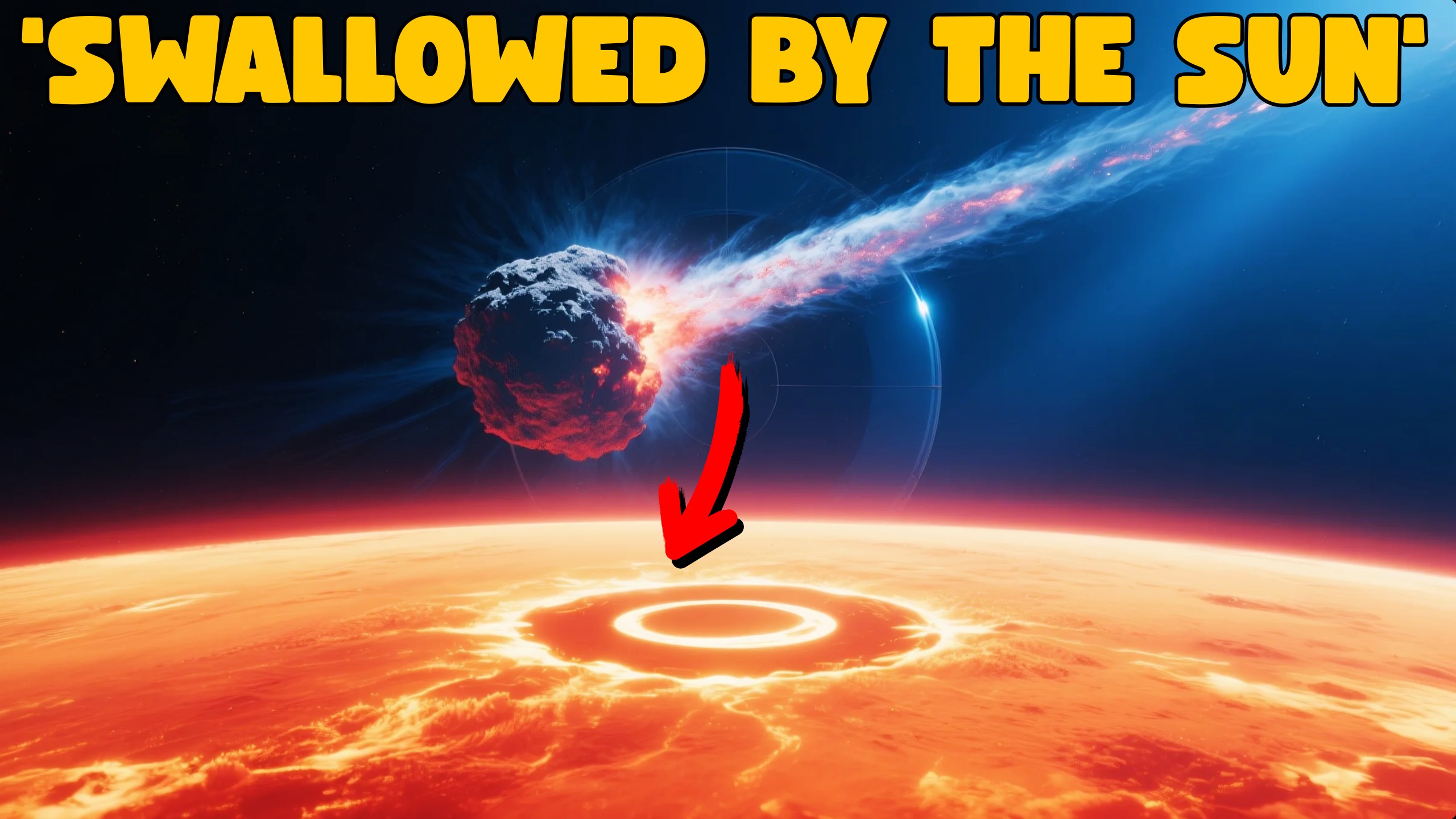
O 3I/ATLAS conquistou rapidamente a atenção da comunidade científica global e dos entusiastas do espaço por um motivo extremamente raro: ele foi confirmado como o terceiro objeto conhecido a se originar fora dos limites do nosso sistema solar.

Sua presença aqui é um lembrete vívido de que visitantes interestelares, embora difíceis de detectar, ocorrem de fato de maneira mais recorrente do que se imaginava, trazendo consigo pedaços de matéria-prima cósmica de regiões distantes da galáxia. Nossos telescópios, com sua crescente sofisticação, finalmente conseguem flagrar essas passagens raras pelas vizinhanças internas onde o Planeta Azul está localizado. Contudo, devido a uma dinâmica orbital crítica e peculiar, estamos prestes a dar um “adeus” temporário ao 3I/ATLAS. O objeto está se movendo rapidamente para uma posição em que será visualmente engolido pelo brilho intenso do Sol, desaparecendo temporariamente do nosso campo de visão terrestre. Este fenômeno não é incomum para cometas, mas é crucial entender exatamente por que este mensageiro interestelar de importância singular está prestes a se tornar invisível para os observadores aqui na Terra.
Para um observador terrestre, a visibilidade de qualquer cometa é determinada por um balanço complexo que envolve seu brilho intrínseco, mas, sobretudo, sua posição relativa em relação ao Sol e à Terra. Mesmo os cometas mais ativos podem sumir repentinamente dos nossos céus. O principal culpado por trás desse fenômeno é o que chamamos de conjunção solar. Este é o momento em que o cometa se aproxima angularmente do Sol, ficando tão próximo em nossa linha de visão que a intensa e avassaladora luz solar ofusca completamente o objeto. O brilho da nossa estrela torna-se um véu intransponível, impossibilitando distingui-lo a olho nu ou mesmo com a maioria dos telescópios. É exatamente o mesmo motivo pelo qual não conseguimos ver as estrelas durante o dia, embora elas permaneçam lá. Quando o 3I/ATLAS entrar nesta conjunção, passando atrás ou perigosamente perto do Sol em nossa perspectiva, ele deixará de ser observável, inaugurando um período de silêncio visual frustrante para a ciência, pois interrompe a coleta contínua de dados essenciais sobre sua trajetória e composição.
A situação se torna ainda mais paradoxal devido à forma como os cometas se comportam. Os cometas apresentam sua maior atividade, liberando o máximo de gases e poeira para formar suas caudas espetaculares, justamente nas proximidades do periélio – o ponto mais próximo do Sol em sua trajetória orbital. Neste ponto, a sublimação do gelo é intensa e, em teoria, o objeto deveria estar incrivelmente brilhante. No entanto, é justamente nesse momento de maior brilho e atividade que o 3I/ATLAS será mais difícil de ver. Da perspectiva terrestre, o objeto está muito próximo, em termos angulares, da imensa e ofuscante bola luminosa que é o nosso Sol. Em outras palavras, o cometa atingirá seu auge de liberação de material, potencialmente exibindo sua cauda em toda sua glória, mas, incrivelmente, estará invisível para os observadores aqui na Terra, escondido atrás da cortina de luz solar.
Embora a Terra experimente esse “apagão” visual, a observação do 3I/ATLAS não será completamente interrompida. Felizmente, existem os vigilantes espaciais, as sondas de observação solar como a SOHO (Solar and Heliospheric Observatory) e o STEREO, que estão posicionadas para monitorar a coroa solar. Esses instrumentos são construídos especificamente para contornar o problema do brilho solar. Eles utilizam complexos discos de ocultação, os chamados coronógrafos, que bloqueiam o brilho intenso do disco solar, permitindo que a coroa (e objetos que passam perto dela) se tornem visíveis. Enquanto para nós, terrestres, o 3I/ATLAS some em uma luz ofuscante, no espaço, esses instrumentos conseguem, em muitas situações, registrar a passagem desses cometas em detalhes. Assim, a ciência tem a garantia de um acompanhamento vital, embora indireto, durante o período de ocultação, provando que o desaparecimento terrestre não significa o fim da coleta de dados.
É crucial entender que um “desaparecimento” pode ter dois significados radicalmente diferentes. Pode ser apenas uma ocultação temporária devido à proximidade angular com o Sol, com o cometa retornando em seguida para novos registros. Mas pode, tragicamente, significar a aniquilação total. Alguns cometas, os chamados “rasantes solares”, fazem mergulhos perigosamente próximos da estrela. Esses objetos podem se desintegrar completamente devido ao calor extremo e às forças de maré gravitacional intensas, jamais retornando ao nosso campo de visão. O Cometa ISON, em 2013, serve como um lembrete histórico desse destino. Ele sumiu da vista terrestre por estar em conjunção solar e, ao invés de reaparecer intacto, restavam apenas fragmentos e poeira. A aproximação do Sol pode selar o destino de muitos objetos. O desaparecimento do 3I/ATLAS, embora frustrante, exige uma checagem cuidadosa para garantir que ele sobreviva à sua passagem crítica.

Felizmente, no caso do 3I/ATLAS, todos os cálculos indicam que seu desaparecimento se enquadra na primeira categoria: uma simples ocultação angular. Sua órbita está nos conduzindo ao período de silêncio visual, no qual os telescópios terrestres serão dominados pela luminosidade solar, impedindo observações diretas por algumas semanas. Atualmente, o cometa ainda se manifesta como um pontinho difuso visível apenas com telescópios sensíveis, próximo à órbita de Marte. Contudo, dia após dia, a distância aparente entre o 3I/ATLAS e o Sol, em nossa linha de visão, diminui inexoravelmente. Essa perda de campo de visão culminará no fim de outubro, coincidindo exatamente com o momento em que Atlas alcança o periélio. É nesse auge de atividade, que ele estará totalmente oculto, perdendo a oportunidade de registrar as caudas potencialmente mais longas e espetaculares formadas pela sublimação máxima de seus materiais.
Ao contrário dos cometas rasantes, 3I/ATLAS oferece um alívio em relação ao risco de desintegração. Sua trajetória é relativamente confortável, com o ponto de periélio ocorrendo a uma distância segura de cerca de 202 milhões de quilômetros do Sol. Isso evita o cenário catastrófico de fragmentação causado pelo calor excessivo e pela poderosa gravidade solar, garantindo que o objeto interestelar sobreviva. Entretanto, o fato de não corrermos o risco de perdê-lo de forma permanente não minimiza a frustração de perdermos o ápice de sua emissão de gases e poeira, quando sua cauda seria mais espetacular. Mesmo assim, a comunidade científica não ficará de mãos abanando. Graças a plataformas espaciais como a SOHO e o STEREO, equipados para ignorar o brilho solar, será possível acompanhar indiretamente a silhueta e a trajetória do 3I/ATLAS, oferecendo dados contínuos que preencherão o vazio deixado pela cegueira terrestre.
É fundamental reiterar a importância única de 3I/ATLAS. Ele não é apenas mais um cometa periódico; é um emissário que atravessou o abismo entre as estrelas, carregando consigo a assinatura química de regiões distantes da Via Láctea. Sua trajetória muito mais veloz e sua provável origem no disco espesso da galáxia o tornam uma peça de estudo incrivelmente rara. Cada fragmento de dados observados, seja sobre a composição de seu núcleo, a estrutura de sua coma ou a cor de sua cauda, fornece pistas vitais sobre a diversidade dos mundos gelados que vagueiam no espaço interestelar. Tais objetos funcionam como janelas para as condições iniciais de formação planetária em outros sistemas. Por essa razão, a espera pelo seu reaparecimento é ansiosa. O período oculto, sem observações diretas, é um hiato no qual poderíamos estar entendendo a formação de gelos e minerais fora do nosso vizinhança solar.
O retorno triunfal do 3I/ATLAS está previsto para o final de novembro, quando ele finalmente se afastará angularmente do Sol e emergirá do ofuscamento, tornando-se novamente visível aos nossos telescópios, mesmo a uma colossal distância de 268 milhões de quilômetros da Terra. No entanto, é improvável que ele volte exatamente como o vimos partir. Durante esse período oculto, o cometa está sujeito a interações intensas com o vento solar e a radiação próxima à nossa estrela. Tais interações podem modificar drasticamente sua aparência: a cauda pode se alongar ainda mais, mudar de orientação ou, em casos mais extremos, o núcleo pode ter sofrido alguma fragmentação. O Sol não apenas o esconde, mas atua como um poderoso agente de mudança em sua estrutura. Quando ele reaparecer, abrirá uma nova e excitante oportunidade de coleta de dados sobre sua composição e estrutura. O desaparecimento é temporário, mas seu retorno promete um objeto transformado pela sua ousada jornada em torno do Sol, pronto para nos revelar novos segredos.
3I/ATLAS quickly captured the attention of the global scientific community and space enthusiasts for an extremely rare reason: it was confirmed as the third known object to originate outside the confines of our solar system. Its presence here is a vivid reminder that interstellar visitors, while difficult to detect, do occur more frequently than previously thought, bringing with them bits of cosmic raw material from distant regions of the galaxy. Our telescopes, with their increasing sophistication, are finally able to capture these rare passages through the inner neighborhood where the Blue Planet is located. However, due to a critical and peculiar orbital dynamic, we are about to bid a temporary “goodbye” to 3I/ATLAS. The object is rapidly moving toward a position where it will be visually engulfed by the intense glare of the Sun, temporarily disappearing from our terrestrial field of view. This phenomenon is not uncommon for comets, but it is crucial to understand exactly why this singularly important interstellar messenger is about to become invisible to observers here on Earth.
For a terrestrial observer, the visibility of any comet is determined by a complex balance involving its intrinsic brightness, but above all, its relative position to the Sun and Earth. Even the most active comets can suddenly disappear from our skies. The main culprit behind this phenomenon is what we call solar conjunction. This is the moment when the comet approaches the Sun at an angular angle, getting so close in our line of sight that the intense and overwhelming sunlight completely obscures the object. The brightness of our star becomes an insurmountable veil, making it impossible to distinguish it with the naked eye or even with most telescopes. This is exactly the same reason we cannot see stars during the day, even though they remain there. When 3I/ATLAS enters this conjunction, passing behind or dangerously close to the Sun from our perspective, it will cease to be observable, ushering in a period of frustrating visual silence for science, as it interrupts the continuous collection of essential data about its trajectory and composition.
The situation becomes even more paradoxical due to the way comets behave. Comets exhibit their greatest activity, releasing the maximum amount of gas and dust to form their spectacular tails, precisely near perihelion—the closest point to the Sun in their orbital trajectory. At this point, ice sublimation is intense, and, in theory, the object should be incredibly bright. However, it is precisely at this moment of greatest brightness and activity that 3I/ATLAS will be most difficult to see. From a terrestrial perspective, the object is very close, angularly, to the immense and blinding ball of light that is our Sun. In other words, the comet will reach its peak of material release, potentially displaying its tail in all its glory, but, incredibly, it will be invisible to observers here on Earth, hidden behind the curtain of sunlight.
Although Earth will experience this visual “blackout,” observation of 3I/ATLAS will not be completely interrupted. Fortunately, there are space watchdogs, solar observation probes like SOHO (Solar and Heliospheric Observatory) and STEREO, which are positioned to monitor the solar corona. These instruments are built specifically to circumvent the problem of solar glare. They use complex occultation disks, called coronagraphs, which block the intense glare of the solar disk, allowing the corona (and objects passing near it) to become visible. While for us on Earth, 3I/ATLAS disappears in a blinding light, in space, these instruments can, in many situations, record the passage of these comets in detail. Thus, science is guaranteed vital, albeit indirect, monitoring during the occultation period, proving that Earth’s disappearance does not mean the end of data collection.
It’s crucial to understand that a “disappearance” can have two radically different meanings. It could be merely a temporary occultation due to the comet’s angular proximity to the Sun, with the comet then returning for new observations. But it could, tragically, mean total annihilation. Some comets, called “sungrazers,” make dangerously close dives to the star. These objects can disintegrate completely due to the extreme heat and intense gravitational tidal forces, never returning to our field of view. Comet ISON, in 2013, serves as a historical reminder of this fate. It disappeared from Earth’s view due to solar conjunction, and instead of reappearing intact, only fragments and dust remained. A close approach to the Sun can seal the fate of many objects. The disappearance of 3I/ATLAS, while frustrating, requires careful monitoring to ensure it survives its critical passage.
Fortunately, in the case of 3I/ATLAS, all calculations indicate that its disappearance falls into the first category: a simple angular occultation. Its orbit is leading us into a period of visual silence, during which ground-based telescopes will be overwhelmed by solar glare, preventing direct observations for a few weeks. Currently, the comet still appears as a diffuse dot visible only with sensitive telescopes, near the orbit of Mars. However, day by day, the apparent distance between 3I/ATLAS and the Sun, in our line of sight, inexorably decreases. This loss of field of view will culminate in late October, coinciding exactly with the moment Atlas reaches perihelion. It is at this peak of activity that it will be completely hidden, missing the opportunity to record the potentially longest and most spectacular tails formed by the maximum sublimation of its material.
Unlike grazing comets, 3I/ATLAS offers a respite from the risk of disintegration. Its trajectory is relatively comfortable, with the perihelion point occurring at a safe distance of about 202 million kilometers from the Sun. This avoids the catastrophic fragmentation scenario caused by excessive heat and powerful solar gravity, ensuring the interstellar object’s survival. However, the fact that we are not at risk of losing it permanently does not minimize the frustration of missing the peak of its gas and dust emission, when its tail would be most spectacular. Even so, the scientific community will not be left empty-handed. Thanks to space platforms such as SOHO and STEREO, equipped to ignore the sun’s glare, it will be possible to indirectly track 3I/ATLAS’s silhouette and trajectory, providing continuous data that will fill the gap left by Earth’s blindness.
It is essential to reiterate the unique importance of 3I/ATLAS. It is not just another periodic comet; it is an emissary that has crossed the abyss between the stars, carrying with it the chemical signature of distant regions of the Milky Way. Its much faster trajectory and its likely origin in the galaxy’s thick disk make it an incredibly rare study piece. Every bit of observed data, whether on the composition of its nucleus, the structure of its coma, or the color of its tail, provides vital clues about the diversity of icy worlds wandering interstellar space. Such objects function as windows into the initial conditions of planetary formation in other systems. For this reason, the wait for its reappearance is anxious. The hidden period, without direct observations, is a hiatus in which we could be understanding the formation of ices and minerals outside our solar neighborhood.
3I/ATLAS’s triumphant return is scheduled for late November, when it will finally move angularly away from the Sun and emerge from the glare, becoming visible again to our telescopes, even at a colossal distance of 268 million kilometers from Earth. However, it is unlikely that it will return exactly as we saw it leave. During this hidden period, the comet is subject to intense interactions with the solar wind and radiation from near our star. Such interactions can drastically alter its appearance: the tail may elongate further, change orientation, or, in more extreme cases, the nucleus may have undergone some fragmentation. The Sun not only hides it, but also acts as a powerful agent of change in its structure. When it reappears, it will open up an exciting new opportunity to collect data on its composition and structure. The disappearance is temporary, but its return promises an object transformed by its daring journey around the Sun, ready to reveal new secrets to us.
Artigos Relacionados


Sobre o Autor

Sou Fabio Russo, desenvolvedor e administrador do site Artesanato Total desde 2015. A mais de 25 anos trabalho com diversos nichos de sites na Internet, sempre presando a qualidade em todos os projetos.
0 Comentários