O Cometa 3I/ATLAS Emitiu um Sinal Alienígena? O Mistério do “Uau!” Reacende!

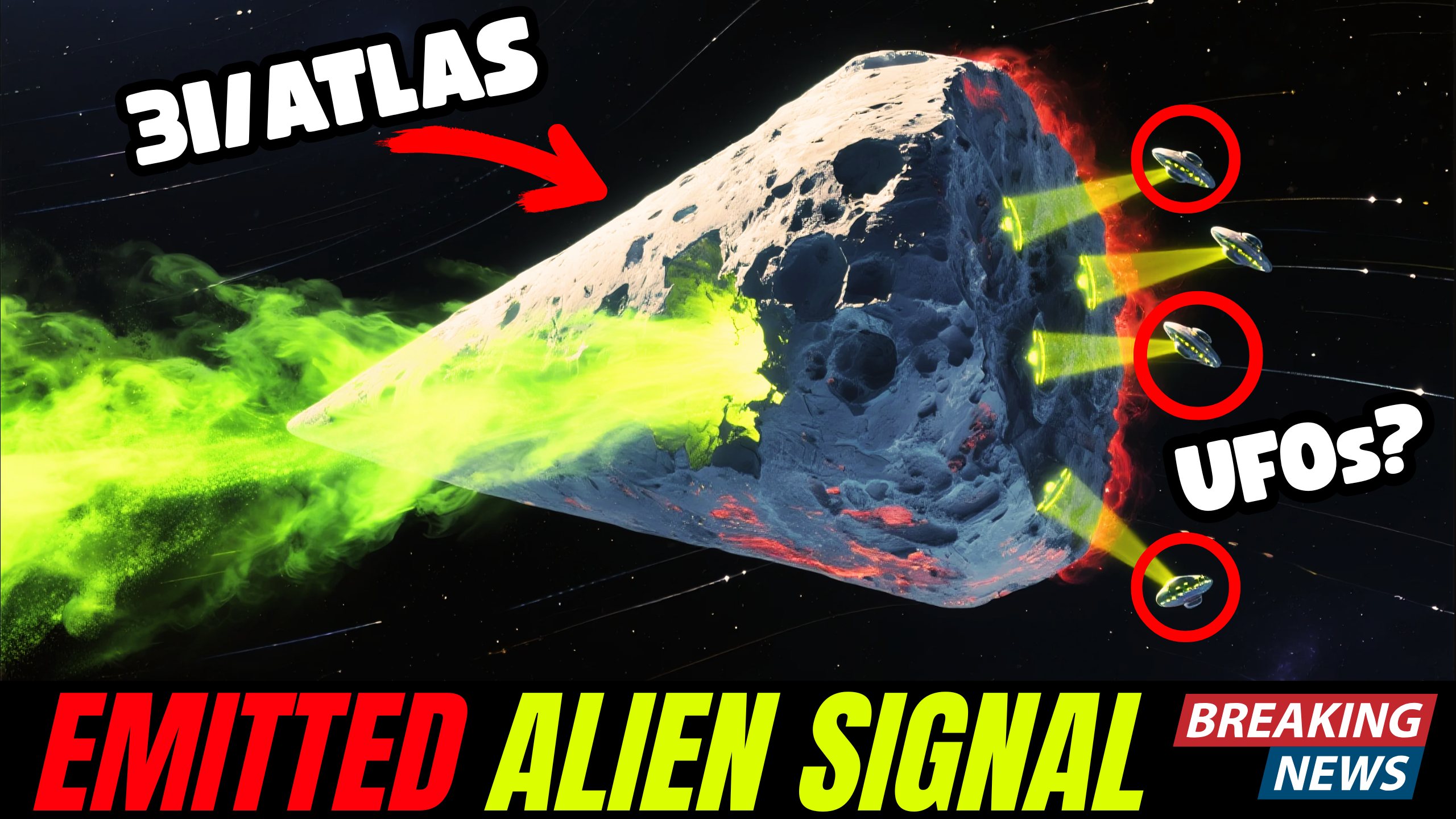
O mistério mais intrigante da astronomia moderna acaba de ganhar um novo capítulo, e ele envolve um cometa recém-descoberto e um sinal de rádio captado há quase 50 anos. Estamos falando do famoso sinal “Uau!”, aquele evento único de 72 segundos que muitos acreditam ter sido uma mensagem de uma civilização alienígena distante.

Mas e se eu disser que a fonte desse enigma pode ser algo muito mais próximo do que imaginamos? Recentemente, um astrônomo conhecido por suas ideias polêmicas levantou uma hipótese chocante: o sinal “Uau!” pode ter vindo do cometa interestelar 3I/ATLAS, descoberto em julho deste ano! Coincidência cósmica ou a peça que faltava no quebra-cabeça extraterrestre? Vamos mergulhar fundo nessa história!
Para quem não se lembra, vamos rebobinar para 15 de agosto de 1977. Naquele dia, o radiotelescópio Big Ear, nos Estados Unidos, detectou um pico de rádio extremamente forte e estreito vindo da constelação de Sagitário. O sinal durou exatamente 72 segundos, o tempo máximo que o telescópio conseguia rastrear um ponto fixo no céu. O astrônomo Jerry Ehman ficou tão perplexo ao revisar os dados que circulou a sequência alfanumérica “6EQUJ5” e escreveu ao lado: “Wow!” – ou “Uau!”. Desde então, esse sinal se tornou o principal candidato a uma transmissão extraterrestre genuína, principalmente porque ele nunca mais se repetiu. Quase meio século depois, ele continua sendo um mistério que desafia todas as explicações convencionais.
Entra em cena o astrofísico Avi Loeb, da Universidade de Harvard. Loeb não é um nome qualquer; ele é famoso por levantar hipóteses ousadas (e, sejamos sinceros, bem controversas), como a de que o objeto interestelar ʻOumuamua poderia ser uma peça de tecnologia alienígena. Agora, Loeb está de volta, apontando o dedo cósmico para o cometa 3I/ATLAS. A grande sacada de Loeb reside na coincidência posicional. Ele calculou que, na época em que o sinal “Uau!” foi detectado, o recém-descoberto cometa 3I/ATLAS estava em uma posição no céu que era incrivelmente próxima da região de Sagitário de onde o sinal foi captado. A diferença era mínima, o que confere uma “plausibilidade estatística” à ideia, com uma probabilidade de apenas 0,6% de ser um mero acaso, segundo seus cálculos.
Mas como um cometa poderia emitir um sinal de rádio tão potente e artificial? Segundo a proposta de Loeb, se o 3I/ATLAS fosse realmente a fonte, ele precisaria estar emitindo uma potência colossal, algo entre 0,5 e 2 gigawatts. Para comparação, isso é o equivalente à energia de um reator nuclear terrestre! Loeb também observa que o sinal “Uau!” estava ligeiramente deslocado para o azul, o que seria consistente com a velocidade com que o cometa 3I/ATLAS estava se aproximando da Terra naquele momento. A implicação? Embora não seja uma explicação óbvia, ela sugere que, talvez, haja algum fenômeno natural (ou artificial, vamos manter as portas abertas!) ocorrendo no cometa que possa gerar essa emissão poderosa.

Antes de comprarmos a ideia, precisamos contextualizar a fonte. Avi Loeb é um verdadeiro “bad boy” da astronomia, no bom sentido. Ele adora questionar o status quo e forçar a comunidade científica a considerar possibilidades que vão além do usual. Suas propostas, como esta, geralmente geram debates acalorados. A comunidade científica frequentemente divide-se: alguns o admiram por sua coragem intelectual; outros o veem como alguém que beira a ficção científica. Essa polarização é importante porque, embora a coincidência de posições do 3I/ATLAS seja intrigante, até agora, não há absolutamente nenhuma evidência observacional direta que confirme qualquer transmissão vinda do cometa. Por enquanto, é apenas uma especulação fascinante.
A busca pela repetição do sinal “Uau!” é incessante. Em 2022, pesquisadores do Instituto SETI (Busca por Inteligência Extraterrestre) realizaram uma das buscas mais detalhadas da história, mirando especificamente a região de Sagitário. Eles focaram em uma estrela semelhante ao Sol, a 1.800 anos-luz de distância, usando potentes radiotelescópios como o Green Bank Telescope (GBT) e o Allen Telescope Array (ATA). Eles observaram por horas, com a esperança de captar qualquer coisa que se parecesse com o “Uau!”. O resultado? Um desapontamento total. Nada. Absolutamente nenhum sinal detectado. Isso reforça a ideia de que o “Uau!” foi, de fato, um evento único, tornando sua origem ainda mais difícil de rastrear e, de certa forma, até adicionando peso à possibilidade de um objeto transitório – como um cometa interestelar.
Vamos falar sobre o outro protagonista dessa história: o cometa 3I/ATLAS. Descoberto em julho de 2025, ele é apenas o terceiro objeto interestelar já identificado, seguindo os passos famosos de ʻOumuamua e do Cometa Borisov. O que o torna especial? Ele tem um núcleo robusto de pelo menos cinco quilômetros de diâmetro, com uma massa estimada em dezenas de bilhões de toneladas. Sua jornada através do nosso Sistema Solar é uma chance rara para os cientistas observarem como os corpos celestes se comportam fora da nossa vizinhança cósmica. Embora Loeb levante a ideia de uma origem artificial, a maior parte da comunidade científica o trata como um cometa natural, ainda que incomum, baseada em seu brilho, aceleração e estimativas de massa.
Então, qual é o veredito? A hipótese de que o 3I/ATLAS seja a fonte do “Uau!” é uma ideia eletrizante que nos faz imaginar possibilidades incríveis. A coincidência posicional é inegável, e os cálculos de Loeb adicionam uma pitada de plausibilidade estatística. No entanto, o ponto crucial é: ciência exige evidência. E no momento, essa evidência simplesmente não existe. Nenhuma observação direta ligou qualquer tipo de transmissão ao cometa. O sinal “Uau!” permanece como um fantasma cósmico, um evento único que resiste à verificação e à repetição, tornando impossível confirmar qualquer teoria – seja ela uma civilização distante, um fenômeno astrofísico aleatório ou, agora, um cometa viajante.
O 3I/ATLAS continua sua jornada pelo nosso sistema solar, e os telescópios de todo o mundo estão de olho em cada movimento e emissão. Os dados coletados serão cruciais para entender suas características e, talvez, determinar se existe alguma chance real de ele ter emitido o sinal “Uau!” décadas atrás. Por enquanto, o mistério persiste. Será que o “Uau!” foi um “adeus” rápido de um cometa interestelar superpotente, ou foi realmente uma mensagem de E.T.? A discussão está mais viva do que nunca. Deixem nos comentários: vocês acham que o Cometa 3I/ATLAS é o culpado, ou isso é apenas uma coincidência cósmica? Não se esqueçam de curtir o vídeo e se inscrever no canal para mais mistérios do universo! Até a próxima!
The most intriguing mystery in modern astronomy has just gained a new chapter, involving a newly discovered comet and a radio signal captured almost 50 years ago. We’re talking about the famous “Wow!” signal, that unique 72-second event that many believe was a message from a distant alien civilization. But what if I told you the source of this enigma could be something much closer than we imagine? Recently, an astronomer known for his controversial ideas put forward a shocking hypothesis: the “Wow!” signal may have come from the interstellar comet 3I/ATLAS, discovered in July of this year! Cosmic coincidence or the missing piece of the extraterrestrial puzzle? Let’s dive deeper into this story!
For those who don’t remember, let’s rewind to August 15, 1977. On that day, the Big Ear radio telescope in the United States detected an extremely strong and narrow radio spike coming from the constellation Sagittarius. The signal lasted exactly 72 seconds, the maximum time the telescope could track a fixed point in the sky. Astronomer Jerry Ehman was so perplexed upon reviewing the data that he circled the alphanumeric sequence “6EQUJ5” and wrote next to it: “Wow!” – or “Wow!” Since then, this signal has become the leading candidate for a genuine extraterrestrial transmission, largely because it has never been repeated. Almost half a century later, it remains a mystery that defies all conventional explanations.
Enter astrophysicist Avi Loeb of Harvard University. Loeb is no ordinary name; he is famous for raising bold (and, let’s be honest, quite controversial) hypotheses, such as that the interstellar object ʻOumuamua could be a piece of alien technology. Now, Loeb is back, pointing the cosmic finger at comet 3I/ATLAS. Loeb’s great insight lies in the positional coincidence. He calculated that, at the time the “Wow!” signal was detected, the newly discovered comet 3I/ATLAS was in a position in the sky incredibly close to the Sagittarius region from which the signal was picked up. The difference was minimal, lending the idea “statistical plausibility,” with a mere 0.6% probability of it being a fluke, according to his calculations.
But how could a comet emit such a powerful, artificial radio signal? According to Loeb’s proposal, if 3I/ATLAS were truly the source, it would need to be emitting a colossal amount of power, somewhere between 0.5 and 2 gigawatts. For comparison, that’s the equivalent of the energy of a terrestrial nuclear reactor! Loeb also notes that the “Wow!” signal was slightly blueshifted, which would be consistent with the speed at which comet 3I/ATLAS was approaching Earth at that time. The implication? While not an obvious explanation, it suggests that perhaps there is some natural (or artificial, let’s keep the door open!) phenomenon occurring on the comet that could generate this powerful emission.
Before we buy into this idea, we need to contextualize the source. Avi Loeb is a true “bad boy” of astronomy, in a good way. He loves to question the status quo and force the scientific community to consider possibilities that go beyond the usual. His proposals, like this one, often generate heated debates. The scientific community is often divided: some admire him for his intellectual courage; others see him as someone who borders on science fiction. This polarization is important because, while the coincidence of 3I/ATLAS’s positions is intriguing, so far, there is absolutely no direct observational evidence to confirm any transmission from the comet. For now, it’s just fascinating speculation.
The search for a repeat of the “Wow!” signal is relentless. In 2022, researchers from the SETI (Search for Extraterrestrial Intelligence) Institute conducted one of the most detailed searches in history, specifically targeting the Sagittarius region. They focused on a Sun-like star 1,800 light-years away, using powerful radio telescopes like the Green Bank Telescope (GBT) and the Allen Telescope Array (ATA). They observed for hours, hoping to capture anything resembling the “Wow!” signal. The result? Total disappointment. Nothing. Absolutely no signal detected. This reinforces the idea that the “Wow!” signal was, in fact, a unique event, making its origin even more difficult to trace and, in some ways, even adding weight to the possibility of a transient object—like an interstellar comet.
Let’s talk about the other protagonist in this story: comet 3I/ATLAS. Discovered in July 2025, it is only the third interstellar object ever identified, following in the famous footsteps of ʻOumuamua and Comet Borisov. What makes it special? It has a robust nucleus at least five kilometers in diameter, with an estimated mass of tens of billions of tons. Its journey through our Solar System is a rare opportunity for scientists to observe how celestial bodies behave outside our cosmic neighborhood. Although Loeb raises the idea of an artificial origin, most of the scientific community treats it as a natural, albeit unusual, comet, based on its brightness, acceleration, and mass estimates.
So, what’s the verdict? The hypothesis that 3I/ATLAS is the source of the “Wow!” is a thrilling idea that invites us to imagine incredible possibilities. The positional coincidence is undeniable, and Loeb’s calculations add a dash of statistical plausibility. However, the crucial point is: science requires evidence. And at the moment, that evidence simply doesn’t exist. No direct observation has linked any kind of transmission to the comet. The “Wow!” signal remains a cosmic ghost, a unique event that resists verification and repetition, making it impossible to confirm any theory—be it a distant civilization, a random astrophysical phenomenon, or, now, a traveling comet.
3I/ATLAS continues its journey through our solar system, and telescopes around the world are watching its every movement and emission. The data collected will be crucial to understanding its characteristics and, perhaps, determining whether there’s any real chance it emitted the “Wow!” signal decades ago. For now, the mystery persists. Was the “Wow!” a quick “goodbye” from a super-powerful interstellar comet, or was it truly a message from E.T.? The debate is more lively than ever. Leave your comments: do you think Comet 3I/ATLAS is the culprit, or is this just a cosmic coincidence? Don’t forget to like the video and subscribe to the channel for more mysteries of the universe! See you next time!
Artigos Relacionados


Sobre o Autor

Sou Fabio Russo, desenvolvedor e administrador do site Artesanato Total desde 2015. A mais de 25 anos trabalho com diversos nichos de sites na Internet, sempre presando a qualidade em todos os projetos.
0 Comentários