O mistério sombrio das cavernas subterrâneas na Capadócia antiga

E se eu te contasse que, muito antes da nossa história, civilizações inteiras desapareceram no subsolo, não por acaso, mas para construir um mundo tão bizarro e cheio de segredos que faz a gente duvidar do que é a vida?

Pense em pessoas que nasciam, viviam e morriam sem nunca sentir a luz do sol, respirando um ar abafado de pedra e terra, dentro de túneis e salas escavadas com uma obsessão inacreditável, escondendo um modo de vida que faria os cabelos da sua nuca se arrepiarem só de imaginar.
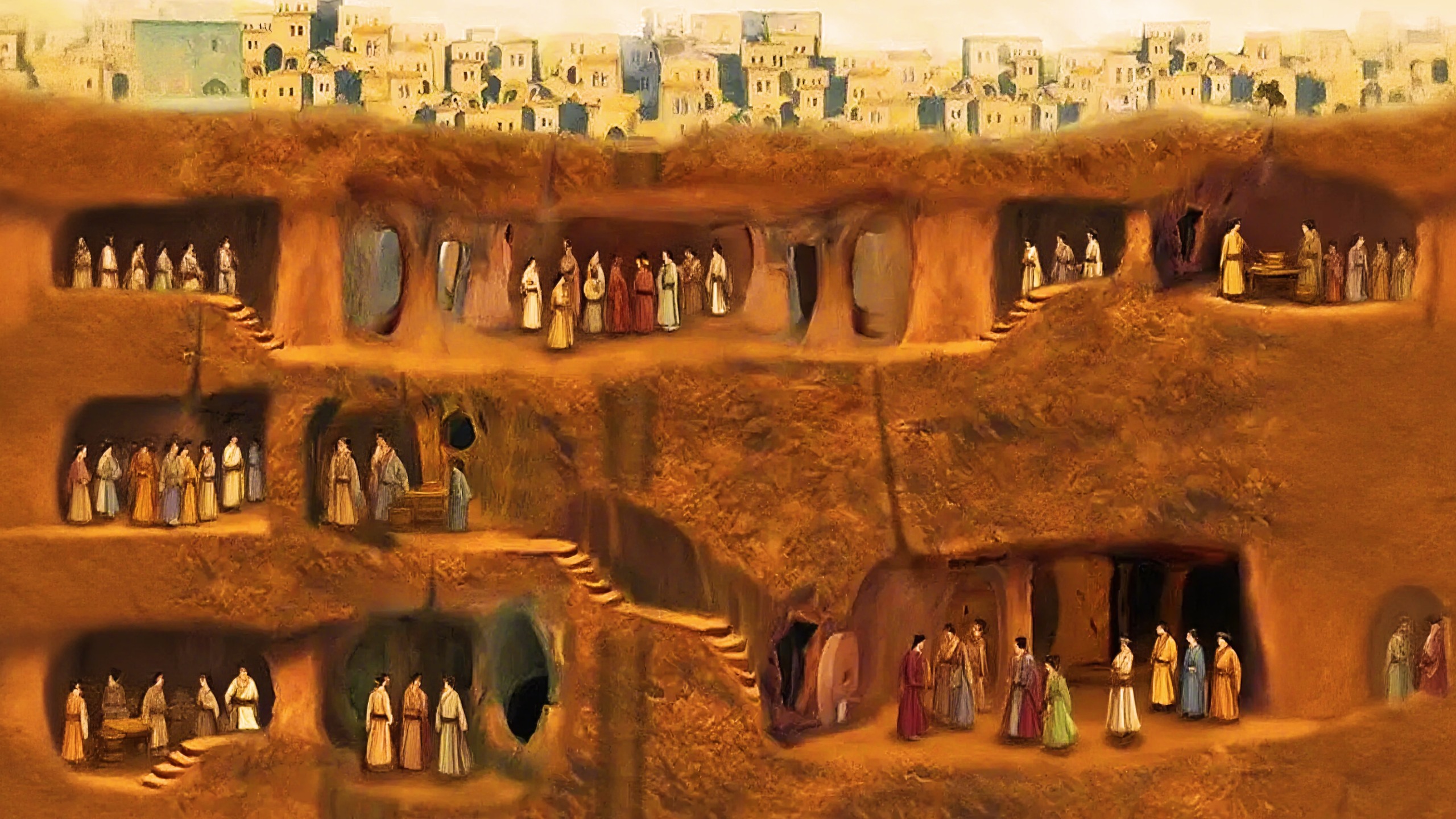
Acontece que, em um lugar na antiga Capadócia, no meio de uma paisagem lunar de cones de rocha e formações bizarras, um povo inteiro não só viveu sob a terra, mas fez disso seu santuário mais sombrio e misterioso. Não estamos falando de algumas caverninhas para se esconder da chuva; imagine cidades gigantescas, complexos subterrâneos com vários andares, labirintos escuros capazes de abrigar milhares de pessoas por anos a fio. Eles literalmente desapareceram do mapa, submergindo em um silêncio assustador para criar uma sociedade que, por escolha ou desespero, renunciou ao mundo da luz. Essas escavações não eram simples abrigos, mas um testemunho macabro de uma fé inabalável em viver nas entranhas do planeta, isolados de tudo e de todos, mantendo segredos tão profundos quanto os túneis que eles construíam. Cada centímetro da rocha bruta era cuidadosamente trabalhado para servir a uma nova realidade, uma vida onde o mundo lá fora era apenas uma lembrança distante ou uma ameaça constante.
Para viver sob a terra desse jeito, sem sol e em ambientes tão confinados, a vida diária era uma disciplina extrema e um pesadelo silencioso para os desavisados. Eles tinham que planejar cada movimento, cada recurso, cada respiração. A comida era guardada em potes gigantes escavados nas rochas, a água vinha de poços profundos ou era desviada de rios subterrâneos – cada gota uma benção. As casas não eram construídas, mas “arrancadas” da pedra, com camas fixas e mobília mínima, tudo feito da própria rocha. A ventilação era um desafio constante, com um sistema engenhoso de dutos de ar finos que se estendiam até a superfície, permitindo a circulação de um ar úmido e pesado, que carregava o cheiro de terra molhada e a respiração de milhares. Viver lado a lado, parede com parede, sem escapatória ou privacidade, transformava cada interação em um ritual de sobrevivência coletiva, onde a paranoia de invasões ou o simples tédio da escuridão podia lentamente corroer a sanidade de qualquer um.
Nesse submundo de escuridão e paredes de rocha, os rituais e a fé tinham um peso e uma intensidade totalmente diferentes. As divindades deles não eram deuses do sol ou das estrelas, mas entidades sombrias e antigas que governavam as profundezas da terra, os espíritos que habitavam as sombras. Imagine cultos realizados em salões de pedra iluminados apenas por fogueiras bruxuleantes, com cânticos que ecoavam nas cavernas e a fumaça subindo pelas fissuras nas rochas, confundindo-se com o ar pesado. Eles acreditavam que, ao viverem tão perto do coração da terra, estavam mais conectados com o misticismo e os mistérios primordiais, buscando proteção contra um mal que eles sentiam emanar da superfície. A escuridão não era um inimigo, mas um véu protetor, uma mãe que os acolhia, e os rituais eram uma forma de honrar essa mãe e as forças ocultas que os mantinham seguros, mas também reféns.
O motivo principal que levava essas pessoas a se enterrarem vivas era a necessidade de sobrevivência frente a ameaças terríveis e implacáveis. Bandos de invasores sanguinários, perseguições religiosas ou conflitos brutais por território transformaram a superfície em um lugar de terror e morte. Para esses povos, viver acima do solo significava ser caçado, escravizado ou massacrado. A única esperança era a invisibilidade, o esquecimento, mergulhar nas entranhas da terra onde seus inimigos não se atveriam a entrar, ou não seriam capazes de encontrá-los. Construir uma cidade inteira debaixo da terra era um ato de desespero e engenhosidade. Cada entrada era cuidadosamente disfarçada, cada corredor planejado para confundir e prender invasores, com armadilhas mortais e pedras gigantescas que poderiam selar as passagens. Eles viveram sob uma constante nuvem de medo, com sentinelas ocultos ouvindo os sons distantes da superfície, prontos para fechar as enormes portas de pedra em segundos, isolando-se completamente do mundo exterior, até que a ameaça passasse, se é que passava.
Dentro desses túneis frios e claustrofóbicos, a organização social era rigidamente controlada, pois a desordem significaria a extinção. A vida subterrânea exigia cooperação total e obediência absoluta. Os líderes, fossem eles anciãos respeitados, xamãs com poderes místicos ou chefes guerreiros endurecidos pelas batalhas da superfície, ditavam todas as regras. Eles eram os guardiões do ar, da água e dos alimentos, controlando a sobrevivência de todos. Cada indivíduo tinha um papel específico, desde cavar e construir até preparar alimentos e manter os poucos animais que podiam viver lá dentro. A união era vital; qualquer desavença ou ato egoísta era visto como uma ameaça à comunidade inteira. O povo, com medo constante do mundo exterior e dependente dos recursos limitados, reagia com uma obediência quase cega, aceitando sacrifícios pessoais em nome da sobrevivência coletiva. A ideia de quebrar as regras ou ser expulso para a superfície, enfrentando os perigos lá fora, era o maior castigo imaginável.
Então, um dia, essas cidades subterrâneas ficaram vazias. Silenciosas. O motivo exato de seu abandono ainda é um dos maiores mistérios da arqueologia, aumentando o caráter chocante da história. Alguns teorizam que as ameaças diminuíram e eles finalmente sentiram-se seguros para retornar à luz do sol. Outros acreditam que uma calamidade interna – talvez uma doença, a escassez de água, um colapso social ou até mesmo algo mais assustador, como uma epidância que dizimou a população rapidamente, um desabamento em massa ou um culto que deu terrivelmente errado – os forçou a abandonar esses lares de pedra, talvez deixando para trás não apenas suas posses, mas também seus mortos e suas crenças. O fato é que esses gigantescos labirintos de pedra foram simplesmente desocupados, como se seus habitantes tivessem, de repente, resolvido uma charada e sumido, deixando para trás um testemunho frio e vazio de uma forma de vida que desafiou tudo o que sabemos sobre a existência humana. As portas de pedra ainda estão lá, prontas para selar o segredo que ainda guardam.

Agora, pare para pensar: por mais bizarro que pareça esse povo que vivia enterrado, em busca de segurança, será que nós, no nosso dia a dia, somos tão diferentes assim? Hoje, não nos enterramos na terra, mas nos perdemos em outros “submundos” construídos por nós mesmos. Nos escondemos atrás de telas de celular, criando realidades digitais onde nos sentimos “seguros” das pressões do mundo real, da interação social direta, ou até das nossas próprias inseguranças. Construímos muros invisíveis com nossas bolhas de conforto, com informações que só confirmam o que já pensamos, evitando o confronto com o diferente. E, quando nos sentimos ameaçados pela complexidade da vida ou pela enxurrada de notícias ruins, buscamos refúgio em nossas “cavernas digitais”, em vez de enfrentar a luz lá fora. Será que, no fundo, a busca por um “abrigo seguro” continua sendo a mesma, só que agora as cavernas são outras, feitas de dados e algoritmos, e os perigos que nos levam a elas são mais sutis, mas talvez tão avassaladores quanto aqueles que empurravam o povo da Capadócia para as profundezas da terra?
Imagine por um segundo a loucura que deve ter sido viver assim, no escuro, ouvindo o próprio eco e a respiração de centenas de pessoas. A paranoia constante de quem vive com medo lá fora. Você não sabe se o sol voltou a brilhar ou se uma tempestade destruiu tudo. Seus olhos teriam que se adaptar à penumbra, sua mente à repetição, sua alma à falta do céu. Pense no peso psicológico, na resiliência ou na desesperança de não poder olhar para o alto, sentir o vento no rosto ou o cheiro da grama. Cada criança nascia e morria sem nunca ter visto o horizonte, sem a noção do que é um céu azul, um pôr do sol vibrante. Isso muda a perspectiva de vida, molda os sonhos e os medos de uma maneira que nós, com todo o nosso conforto e tecnologia, mal conseguimos compreender. É uma solidão coletiva, uma vida que era um eterno sussurro na escuridão.
E como será que a convivência funcionava nesse cenário tão extremo? Se hoje, com tanto espaço e individualidade, já é difícil evitar conflitos no trabalho ou em casa, imagine a pressão de ter que compartilhar cada canto, cada recurso vital, cada segundo de vida, dia após dia, ano após ano. A sobrevivência de um dependia da obediência de todos. Cada tosse alta, cada passo pesado podia ser um incômodo para quem estava ao lado. A rotina era o ar que respiravam, uma sequência monórbida de tarefas que mantinham todos vivos. Não tinha como ter segredos ou ambições muito pessoais; a individualidade era luxo, e a coletividade, uma questão de vida ou morte. É quase como se a própria rocha que os abrigava também moldasse seus pensamentos, os aprisionando não só fisicamente, mas também mentalmente em uma rede de interdependência absoluta.
Será que o preço dessa segurança era alto demais? Trocar a vastidão do mundo pela claustrofobia eterna, o som dos pássaros pelo silêncio opressor das pedras, a luz do sol por fogueiras bruxuleantes. Eles se livraram de inimigos visíveis, mas abraçaram um inimigo invisível: a própria escuridão e o confinamento que lentamente devoravam a alma. Quantos de nós hoje não estamos dispostos a abrir mão de parte da nossa liberdade e privacidade em nome de uma “segurança” oferecida pelos sistemas, pela vigilância constante, pelas bolhas de conforto que criamos? A história dessas cidades subterrâneas nos força a pensar: até que ponto estamos dispostos a ceder do nosso espaço, da nossa luz, para nos sentirmos protegidos do que está lá fora? A troca pode ser sutil hoje, mas o fundo da questão é o mesmo.
A Capadócia nos mostra um povo que fugiu de perigos claros e físicos. Mas e se os maiores perigos não forem aqueles que vemos, mas aqueles que criamos dentro de nós? A ansiedade que nos faz querer fugir, o estresse que nos isola em nossos “quartos escuros” particulares, as pressões sociais que nos empurram para esconder quem realmente somos, construindo máscaras e personagens. Não será que, de certa forma, vivemos em nossas próprias cidades subterrâneas mentais, escondendo nossos medos, nossas vulnerabilidades, nossas paixões mais profundas, para nos “proteger” do julgamento alheio ou da complexidade da vida? A vida nas cavernas era real para eles. Para nós, as cavernas podem ser metafóricas, mas não menos reais no seu poder de nos isolar e consumir. É uma história que nos assombra porque, no fundo, fala sobre a parte mais vulnerável e escondida da natureza humana.
O que você achou dessa história arrepiante? Já tinha ouvido falar dessas cidades subterrâneas e de um modo de vida tão isolado e radical? Conte nos comentários o que essa revelação te fez sentir, se ela te chocou ou te deixou pensando em outras coisas da nossa própria vida. Sua opinião é superimportante para a gente! E se você ficou fascinado por essa viagem ao passado, não esqueça de deixar seu like, se inscrever no canal e ativar o sininho das notificações! Vem muito mais por aí, com histórias igualmente chocantes e fascinantes da antiguidade que prometem te deixar grudado na tela!
The Dark Mystery of the Underground Caves in Ancient Cappadocia
What if I told you that, long before our history, entire civilizations disappeared underground, not by chance, but to build a world so bizarre and full of secrets that it makes us doubt what life is? Think of people who were born, lived, and died without ever feeling sunlight, breathing a stifling air of stone and earth, inside tunnels and rooms excavated with incredible obsession, hiding a way of life that would make the hairs on the back of your neck stand up just imagining it.
It turns out that, in a place in ancient Cappadocia, amidst a lunar landscape of rock cones and bizarre formations, an entire people not only lived underground, but made it their darkest and most mysterious sanctuary. We’re not talking about a few small caves to hide from the rain; imagine gigantic cities, multi-story underground complexes, dark labyrinths capable of housing thousands of people for years on end. They literally disappeared from the map, submerging themselves in a terrifying silence to create a society that, by choice or desperation, renounced the world of light. These excavations were not simple shelters, but a macabre testament to an unshakable faith in living in the bowels of the planet, isolated from everything and everyone, keeping secrets as deep as the tunnels they built. Every inch of the raw rock was carefully crafted to serve a new reality, a life where the outside world was either a distant memory or a constant threat.
To live underground like this, without sunlight and in such confined environments, daily life was an extreme discipline and a silent nightmare for the unwary. They had to plan every movement, every resource, every breath. Food was stored in giant jars carved into the rocks, water came from deep wells or diverted from underground rivers—every drop a blessing. Houses were not built, but “torn” from the stone, with fixed beds and minimal furniture, all made from the rock itself. Ventilation was a constant challenge, with an ingenious system of thin air ducts extending to the surface, allowing the circulation of humid, heavy air, carrying the smell of wet earth and the breath of thousands. Living side by side, wall to wall, with no escape or privacy, transformed every interaction into a ritual of collective survival, where paranoia of invasion or the simple boredom of darkness could slowly erode anyone’s sanity.
In this underworld of darkness and rock walls, rituals and faith carried a completely different weight and intensity. Their deities were not gods of the sun or stars, but dark, ancient entities that ruled the depths of the earth, the spirits that inhabited the shadows. Imagine cults held in stone halls lit only by flickering fires, with chants echoing through the caverns and smoke rising from fissures in the rocks, mingling with the heavy air. They believed that by living so close to the heart of the earth, they were more connected to mysticism and primordial mysteries, seeking protection from an evil they felt emanating from the surface. The darkness was not an enemy, but a protective veil, a mother who welcomed them, and the rituals were a way of honoring this mother and the hidden forces that kept them safe, but also hostage.
The main reason these people buried themselves alive was the need to survive in the face of terrible and relentless threats. Bloodthirsty bands of invaders, religious persecutions, or brutal conflicts over territory transformed the surface into a place of terror and death. For these people, living above ground meant being hunted, enslaved, or massacred. Their only hope was invisibility, oblivion, plunging into the bowels of the earth where their enemies would not dare enter, or would not be able to find them. Building an entire city underground was an act of desperation and ingenuity. Every entrance was carefully disguised, every corridor designed to confuse and trap intruders, with deadly traps and giant stones that could seal the passages. They lived under a constant cloud of fear, with hidden sentries listening for distant sounds from the surface, ready to close the massive stone doors in seconds, completely sealing themselves off from the outside world until the threat passed, if it ever did.
Within these cold, claustrophobic tunnels, social organization was tightly controlled, for disorder would mean extinction. Life underground demanded total cooperation and absolute obedience. Leaders, whether respected elders, shamans with mystical powers, or battle-hardened warrior chiefs from the surface, dictated all the rules. They were the guardians of air, water, and food, controlling everyone’s survival. Each individual had a specific role, from digging and building to preparing food and tending the few animals that could live within. Unity was vital; any disagreement or selfish act was seen as a threat to the entire community. The people, constantly afraid of the outside world and dependent on limited resources, reacted with almost blind obedience, accepting personal sacrifices in the name of collective survival. The thought of breaking the rules or being expelled to the surface, facing the dangers outside, was the greatest punishment imaginable.
Then, one day, these underground cities were empty. Silent. The exact reason for their abandonment remains one of archaeology’s greatest mysteries, adding to the shocking nature of the story. Some theorize that threats subsided, and they finally felt safe to return to the sunlight. Others believe that an internal calamity—perhaps a disease, a water shortage, a social collapse, or even something more terrifying, like an epidemic that rapidly decimated the population, a mass collapse, or a cult gone horribly wrong—forced them to abandon these stone homes, perhaps leaving behind not only their possessions but also their dead and their beliefs. The fact is, these gigantic stone labyrinths were simply vacated, as if their inhabitants had suddenly solved a riddle and vanished, leaving behind a cold, empty testament to a life form that defied everything we know about human existence. The stone doors are still there, ready to seal the secret they still hold.
Now, stop and think: as bizarre as it may seem, these people who lived underground, seeking safety, are we, in our daily lives, really that different? Today, we don’t bury ourselves in the earth, but rather lose ourselves in other “underworlds” of our own making. We hide behind cell phone screens, creating digital realities where we feel “safe” from the pressures of the real world, from direct social interaction, or even from our own insecurities. We build invisible walls with our comfort bubbles, with information that only confirms what we already believe, avoiding confrontation with what’s different. And when we feel threatened by life’s complexity or the flood of bad news, we seek refuge in our “digital caves” rather than facing the light outside. Could it be that, deep down, the search for a “safe haven” remains the same, only now the caves are different, made of data and algorithms, and the dangers that lead us to them are more subtle, but perhaps as overwhelming as those that pushed the people of Cappadocia into the depths of the earth?
Imagine for a second the madness it must have been to live like that, in the dark, hearing your own echo and the breathing of hundreds of people. The constant paranoia of those living in fear out there. You don’t know if the sun has shone again or if a storm has destroyed everything. Your eyes would have to adapt to the darkness, your mind to the repetition, your soul to the lack of sky. Think of the psychological toll, the resilience, or the hopelessness of not being able to look up, feel the wind on your face, or smell the grass. Every child was born and died without ever seeing the horizon, without the notion of a blue sky, a vibrant sunset. This changes our perspective on life, shaping our dreams and fears in ways that we, with all our comfort and technology, can barely comprehend. It’s a collective loneliness, a life that was an eternal whisper in the darkness.
And how did coexistence function in such an extreme scenario? If today, with so much space and individuality, it’s difficult to avoid conflicts at work or at home, imagine the pressure of having to share every corner, every vital resource, every second of life, day after day, year after year. One’s survival depended on the obedience of all. Every loud cough, every heavy footstep could be a nuisance to those nearby. Routine was the air they breathed, a monotonous sequence of tasks that kept everyone alive. There was no room for secrets or overly personal ambitions; individuality was a luxury, and collectivity, a matter of life or death. It’s almost as if the very rock that sheltered them also shaped their thoughts, imprisoning them not only physically but also mentally in a web of absolute interdependence.
Was the price of this security too high? Trading the vastness of the world for eternal claustrophobia, the sound of birds for the oppressive silence of the stones, sunlight for flickering campfires. They freed themselves from visible enemies, but embraced an invisible enemy: the very darkness and confinement that slowly devoured their souls. How many of us today are unwilling to give up some of our freedom and privacy in the name of “security” offered by systems, by constant surveillance, by the bubbles of comfort we create? The story of these underground cities forces us to consider: to what extent are we willing to give up our space, our light, to feel protected from what’s out there? The exchange may be subtle today, but the heart of the matter is the same.
Cappadocia shows us a people who fled from clear, physical dangers. But what if the greatest dangers are not those we see, but those we create within ourselves? The anxiety that makes us want to run away, the stress that isolates us in our private “dark rooms,” the social pressures that push us to hide who we truly are, constructing masks and personas. Could it be that, in a way, we live in our own mental underground cities, hiding our fears, our vulnerabilities, our deepest passions, to “protect” ourselves from the judgment of others or from the complexity of life? Life in caves was real for them. For us, caves may be metaphorical, but no less real in their power to isolate and consume us. It’s a story that haunts us because, deep down, it speaks to the most vulnerable and hidden part of human nature.
What did you think of this chilling story? Had you ever heard of these underground cities and such an isolated and radical way of life? Tell us in the comments how this revelation made you feel, whether it shocked you or left you thinking about other things in our own lives. Your opinion is super important to us! And if you were fascinated by this journey into the past, don’t forget to like, subscribe to the channel, and turn on the notification bell! There’s much more to come, with equally shocking and fascinating stories from antiquity that promise to keep you glued to the screen!
Artigos Relacionados


Sobre o Autor

Sou Fabio Russo, desenvolvedor e administrador do site Artesanato Total desde 2015. A mais de 25 anos trabalho com diversos nichos de sites na Internet, sempre presando a qualidade em todos os projetos.
0 Comentários