O SEGREDO OBSCURO dos GATOS Egípcios: Isso vai CHOCAR você!

Prepare-se, porque o que você está prestes a descobrir sobre as civilizações antigas vai abalar suas certezas e talvez te tirar o sono. Vamos mergulhar juntos em detalhes chocantes e práticas perturbadoras da cultura antiga que, tenho certeza, muitos de vocês nunca sequer imaginaram.

São revelações que desafiam nossa compreensão do passado, e mostram o quão bizarra e fascinante a mente humana pode ser quando moldada por crenças profundas e, por vezes, aterrorizantes. Antes de começarmos, por favor, escrevam imediatamente nos comentários abaixo os nomes de pessoas que vocês desejam proteger espiritualmente contra qualquer influência negativa.
No Egito Antigo, a veneração animal atingiu patamares que beiravam o inacreditável, mas nenhuma espécie foi tão exaltada e cultuada quanto o gato. Longe de serem meros animais de estimação, os gatos eram vistos como seres sagrados, manifestações divinas e portadores de imenso poder espiritual. Imagine uma sociedade inteira onde esses felinos eram tratados com um respeito quase religioso, possuidores de um status social superior ao de muitos humanos. Eles eram considerados uma bênção de Bastet, a deusa felina da fertilidade, da proteção e da alegria, e acreditava-se que sua presença trazia sorte e afastamento de maus espíritos, ou até mesmo pragas. A conexão era tão profunda que ferir um gato, mesmo que acidentalmente, poderia levar a consequências terríveis e irreversíveis para o culpado.
Os rituais em homenagem a esses seres misteriosos e adorados eram ao mesmo tempo fascinantes e macabros. Em templos dedicados a Bastet, centenas, senão milhares, de gatos eram mantidos em santuários luxuosos, alimentados com os melhores alimentos e tratados como membros da realeza divina. Peregrinos viajavam de longe para oferecer pequenas estátuas de gatos como oferendas, e havia festivais anuais extravagantes em Bubastis, a cidade sagrada de Bastet, onde a bebida corria solta e celebrações em massa homenageavam a deusa felina e seus representantes terrestres. As pessoas acreditavam que a cada rugido, a cada miado, os gatos comunicavam-se com o plano divino, e a sorte da colheita, a proteção da casa ou a cura de uma doença, poderiam depender do humor de um felino sagrado.
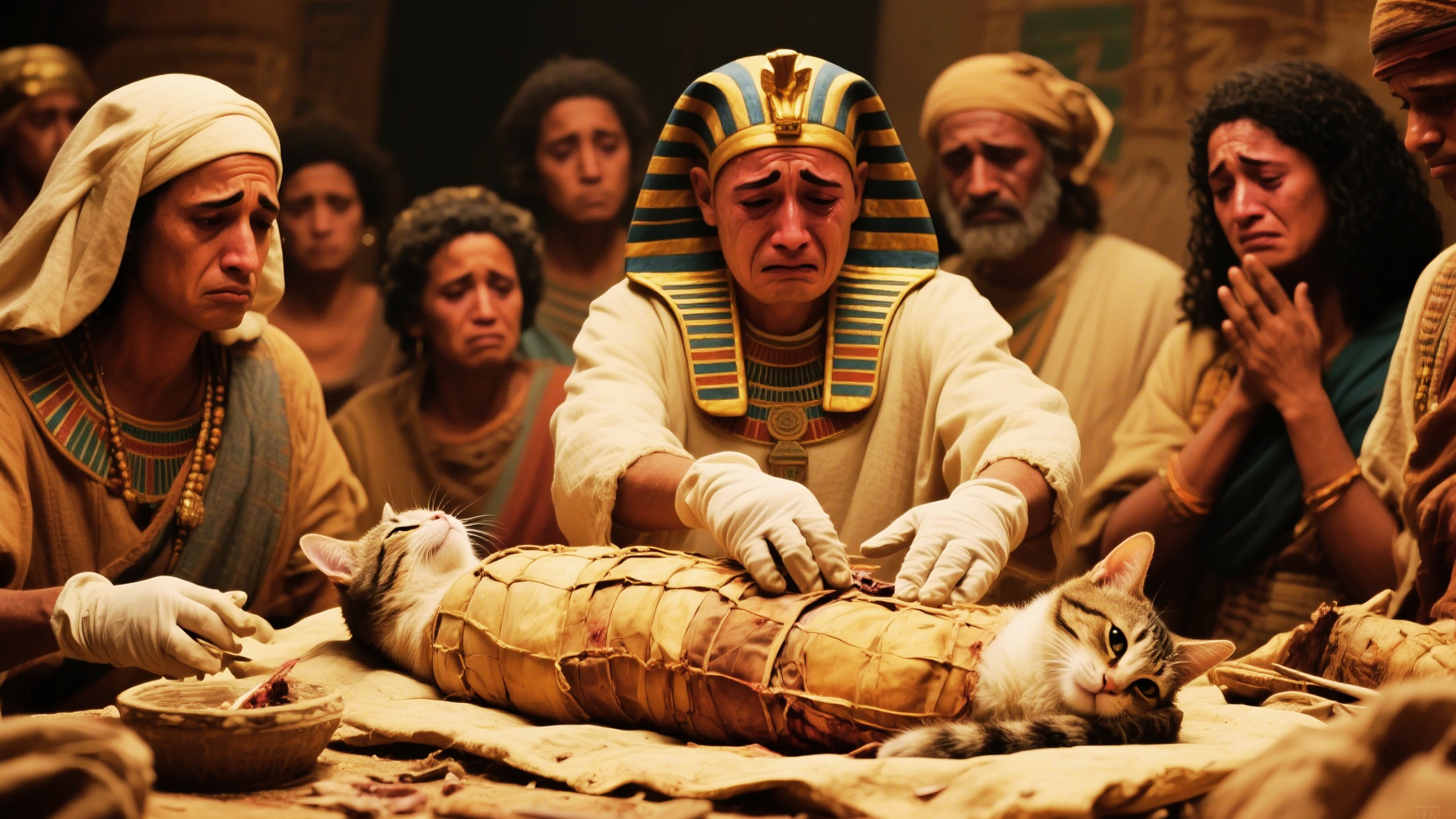
O respeito pelos gatos era tão visceral que a morte de um felino em uma residência mergulhava a família em luto profundo. As pessoas raspavam as sobrancelhas como um sinal de pesar, e a casa era tomada por um clima de tristeza comparável à perda de um filho. E o que acontecia após a morte desses adorados animais? Bem, a história fica ainda mais surpreendente. Os gatos eram mumificados com o mesmo cuidado e ritualístico dedicado aos faraós e nobres. Milhares de gatos, filhotes e adultos, eram cuidadosamente embalsamados, seus corpos envoltos em faixas de linho elaboradas, seus olhos adornados com desenhos e até mesmo pequenas joias, antes de serem colocados em sarcófagos feitos de madeira, bronze ou argila, em cemitérios de animais sagrados.
Essas múmias de gatos eram mais do que apenas um sinal de carinho; elas eram uma manifestação física da crença egípcia na vida após a morte e na conexão espiritual contínua. As múmias eram, muitas vezes, oferecidas como presentes aos deuses em troca de bençãos ou para garantir que a família seria acompanhada por seus gatos na eternidade. Imagine a grandiosidade de um projeto arqueológico que desenterrou vastas necrópoles de gatos, revelando túmulos com milhares e milhares de felinos, todos cuidadosamente preservados, alguns com a efígie de Bastet. É uma demonstração chocante da magnitude da sua veneração e da sua profunda fé no poder espiritual dos gatos.
As leis que protegiam os gatos eram tão severas que chegavam a ser cruéis aos olhos modernos. Quem quer que fosse pego machucando ou, pior ainda, matando um gato – intencionalmente ou não – enfrentava a pena de morte. Historiadores narram relatos de tumultos populares e linchamentos de pessoas que, sem querer, atropelaram um gato com uma carroça ou o feriram em uma briga. O crime era tão hediondo que não havia tribunais para julgar; a própria população agia como júri e carrasco. A gravidade de tais leis sublinha a profunda interligação entre a vida cotidiana, a religião e a ordem social no Egito Anto; a proteção dos gatos não era apenas uma questão legal, mas um imperativo religioso.
A intensidade dessa adoração pode parecer excessiva hoje, mas para os egípcios, os gatos não eram apenas animais; eram parte integrante do tecido social e espiritual. Eles representavam qualidades divinas, protegiam as colheitas dos roedores, guardavam os lares e atuavam como mediadores entre o mundo humano e o divino. A crença era tão arraigada que, quando um exército persa invadiu o Egito, estrategicamente eles usaram gatos à frente de suas tropas, sabendo que os egípcios não ousariam ferir os animais sagrados, preferindo se render a manchar sua própria fé. Isso demonstra o poder inimaginável que os gatos detinham sobre uma das maiores civilizações da antiguidade.
Pense por um momento: uma civilização tão avançada e complexa, capaz de construir pirâmides e desenvolver uma escrita sofisticada, também dedicava sua fé e, em alguns casos, sua vida, à proteção de gatos. É a prova de que a espiritualidade e o misticismo podem assumir formas diversas e profundas, moldando a realidade e as prioridades de uma nação. Essa veneração não era apenas um costume; era um estilo de vida, uma filosofia que perpassava todas as camadas da sociedade, desde o faraó até o mais humilde camponês. Eles viam nos olhos de um gato a centelha do divino, uma ponte para o sagrado, algo que nós, em nossa modernidade, talvez tenhamos esquecido de procurar.

Parando para refletir sobre essa reverência quase fanática por gatos no Egito Antigo, não podemos deixar de nos perguntar: onde está a nossa devoção hoje? Onde colocamos a nossa fé inabalável, o nosso compromisso mais profundo? Eles enxergavam o divino em um animal de quatro patas, e suas vidas eram regidas por esse elo com uma convicção que nos desafia. No nosso mundo acelerado, muitas vezes corremos em busca de status, bens materiais, ou validação nas redes sociais, e acabamos esquecendo de nutrir o que é verdadeiramente sagrado dentro de nós: nossa integridade, nossa capacidade de amar, de perdoar, de criar laços reais. Essa história milenar é um lembrete poderoso de que a profundidade da nossa fé, a força das nossas crenças e o cuidado com que tratamos o que consideramos valioso, moldam não apenas a nossa existência individual, mas o destino de toda uma sociedade. Se uma civilização inteira pôde se unir sob a égide da proteção a um felino, imagine o que nós, com nossa tecnologia e conhecimento, poderíamos realizar se nos uníssemos em prol do respeito genuíno à vida, da compaixão universal e da busca por uma verdade interior que nos liberte. A herança dessa civilização nos desafia a olhar para dentro: quais são os nossos valores supremos e quão dispostos estamos a defendê-los, a cultivá-los e a transmiti-los?
E enquanto nos chocamos com as práticas de mumificação e pena de morte por um gato, há uma camada mais sutil e profunda na sabedoria egípcia que ressoa em nossos corações: a forma como eles buscavam o sagrado no cotidiano, naquilo que os cercava. Para eles, a proteção do gato não era apenas uma lei draconiana, mas um caminho para a harmonia com o universo, para agradar os deuses e garantir a ordem cósmica. Essa percepção profunda de interconexão pode nos parecer estranha, mas ela nos faz pensar: em um mundo onde a vida parece se tornar cada vez mais descartável e a conexão com o sagrado muitas vezes se dilui, a história do Egito nos convida a resgatar essa percepção de que cada ser vivo – do menor inseto ao maior animal – carrega uma faísca de vida, um reflexo do divino. Não é preciso mumificar ou ter medo da pena de morte para honrar a vida; basta cultivarmos a gentileza, a gratidão e a consciência de que o bem que fazemos ao outro – seja ele um animal indefeso, uma pessoa necessitada ou o próprio planeta – retorna para nós de maneiras inesperadas e profundamente recompensadoras. Pense nas pessoas em sua vida que você ama, ou em seu animal de estimação, e em como a proteção e o amor dedicados a eles criam uma corrente invisível de energia positiva, que reverbera e nos protege, talvez mais do que qualquer ritual antigo poderia fazer.
E assim, voltando aos nossos dias, essa história da devoção aos gatos nos remete a uma verdade mais profunda: a necessidade de cultivar respeito e cuidado por todos os seres vivos e pela natureza. Da mesma forma que os egípcios veneravam os gatos como elos com o divino, hoje precisamos cultivar uma conexão de harmonia espiritual em nossa vida. É fundamental buscar a paz interior, exercitar o perdão para si e para os outros, e renovar nossa fé a cada amanhecer, não em deuses felinos, mas nos princípios que nos conectam à bondade, à compaixão e à elevação espiritual. Como naquela época, o zelo pela vida é a base para a proteção e para a prosperidade da alma. Mais uma vez, convido vocês a deixarem nos comentários abaixo os nomes de quem precisa de uma oração para proteção espiritual; incluirei todos esses nomes no poderoso rosário que realizarei para abençoá-los e protegê-los.
O que vocês acharam deste tema tão impactante e perturbador? Já conheciam essa prática fascinante do Egito Antigo e a profundidade da adoração aos gatos? Deixem suas opiniões sinceras e pessoais nos comentários abaixo. Não esqueçam de curtir este vídeo para que ele alcance mais pessoas e, claro, inscrevam-se no canal para não perderem os próximos conteúdos chocantes e reveladores que ainda estão por vir. Sua participação é crucial para que possamos continuar desvendando os segredos do passado e suas conexões com o presente!
Get ready, because what you’re about to discover about ancient civilizations will shake your beliefs and perhaps keep you awake at night. We’ll delve together into shocking details and disturbing practices of ancient culture that I’m sure many of you have never even imagined. These are revelations that challenge our understanding of the past and show how bizarre and fascinating the human mind can be when shaped by deep and sometimes terrifying beliefs. Before we begin, please immediately write in the comments below the names of people you wish to spiritually protect from any negative influence. At the end of this video, I will offer a powerful prayer, including each of these names.
In Ancient Egypt, animal veneration reached heights that bordered on the unbelievable, but no species was as exalted and worshipped as the cat. Far from being mere pets, cats were seen as sacred beings, divine manifestations, and bearers of immense spiritual power. Imagine an entire society where these felines were treated with almost religious respect, holding a higher social status than many humans. They were considered a blessing from Bastet, the feline goddess of fertility, protection, and joy, and their presence was believed to bring good luck and ward off evil spirits, or even plagues. The connection was so deep that harming a cat, even accidentally, could lead to dire and irreversible consequences for the guilty party.
The rituals honoring these mysterious and worshipped beings were at once fascinating and macabre. In temples dedicated to Bastet, hundreds, if not thousands, of cats were kept in luxurious sanctuaries, fed the finest foods, and treated like members of divine royalty. Pilgrims traveled from far and wide to offer small cat statues as offerings, and there were extravagant annual festivals in Bubastis, Bastet’s sacred city, where drinking flowed freely and mass celebrations honored the feline goddess and her earthly representatives. People believed that with every roar and meow, cats communicated with the divine, and the fortune of the harvest, the protection of the home, or the cure of an illness could depend on the mood of a sacred feline.
Respect for cats was so visceral that the death of a feline in a household plunged the family into deep mourning. People shaved their eyebrows as a sign of grief, and the house was filled with an atmosphere of sadness comparable to the loss of a child. And what happened after the death of these beloved animals? Well, the story gets even more surprising. Cats were mummified with the same care and ritualistic care given to pharaohs and nobles. Thousands of cats, kittens and adults, were carefully embalmed, their bodies wrapped in elaborate linen swaddles, their eyes adorned with designs and even small jewels, before being placed in sarcophagi made of wood, bronze, or clay in sacred animal cemeteries.
These cat mummies were more than just a sign of affection; they were a physical manifestation of the Egyptian belief in the afterlife and continued spiritual connection. Mummies were often offered as gifts to the gods in exchange for blessings or to ensure that a family would be accompanied by their cats in eternity. Imagine the enormity of an archaeological project that unearthed vast cat necropolises, revealing tombs containing thousands upon thousands of felines, all carefully preserved, some bearing the image of Bastet. It is a shocking demonstration of the magnitude of their veneration and their deep faith in the spiritual power of cats.
The laws protecting cats were so severe that they border on cruel to modern eyes. Anyone caught harming or, worse yet, killing a cat—intentionally or unintentionally—faced the death penalty. Historians recount accounts of mob riots and lynchings of people who accidentally ran over a cat with a cart or injured it in a fight. The crime was so heinous that there were no courts to judge; the population itself acted as jury and executioner. The severity of such laws underscores the deep interconnection between daily life, religion, and social order in Ancient Egypt; the protection of cats was not just a legal matter, but a religious imperative.
The intensity of this worship may seem excessive today, but for the Egyptians, cats were not just animals; they were an integral part of the social and spiritual fabric. They represented divine qualities, protected crops from rodents, guarded homes, and acted as mediators between the human and divine worlds. The belief was so ingrained that when a Persian army invaded Egypt, they strategically placed cats at the head of their troops, knowing that the Egyptians would not dare harm the sacred animals, preferring to surrender rather than tarnish their own faith. This demonstrates the unimaginable power that cats held over one of the greatest civilizations of antiquity.
Think for a moment: a civilization so advanced and complex, capable of building pyramids and developing sophisticated writing, also dedicated its faith, and in some cases, its life, to the protection of cats. It is proof that spirituality and mysticism can take diverse and profound forms, shaping the reality and priorities of a nation. This veneration was not just a custom; it was a way of life, a philosophy that permeated all strata of society, from the pharaoh to the humblest peasant. They saw in the eyes of a cat the spark of the divine, a bridge to the sacred, something that we, in our modern age, have perhaps forgotten to seek.
Pausing to reflect on this almost fanatical reverence for cats in Ancient Egypt, we can’t help but wonder: where is our devotion today? Where do we place our unshakable faith, our deepest commitment? They saw the divine in a four-legged animal, and their lives were governed by this bond with a conviction that challenges us. In our fast-paced world, we often chase status, material possessions, or social media validation, and we end up forgetting to nurture what is truly sacred within us: our integrity, our capacity to love, to forgive, to create real bonds. This ancient story is a powerful reminder that the depth of our faith, the strength of our beliefs, and the care with which we treat what we consider valuable shape not only our individual existence, but the destiny of an entire society. If an entire civilization could unite under the umbrella of protecting a feline, imagine what we, with our technology and knowledge, could accomplish if we united in support of genuine respect for life, universal compassion, and the search for an inner truth that liberates us. The legacy of this civilization challenges us to look within: what are our supreme values, and how willing are we to defend, cultivate, and transmit them?
And while we are shocked by the practices of mummification and the death penalty for a cat, there is a more subtle and profound layer of Egyptian wisdom that resonates in our hearts: the way they sought the sacred in everyday life, in their surroundings. For them, the protection of the cat was not just a draconian law, but a path to harmony with the universe, to please the gods and ensure cosmic order. This profound perception of interconnection may seem strange to us, but it makes us think: in a world where life seems increasingly disposable and the connection with the sacred is often diluted, the story of Egypt invites us to reclaim this perception that every living being—from the smallest insect to the largest animal—carries a spark of life, a reflection of the divine. There’s no need to mummify or fear the death penalty to honor life; we simply need to cultivate kindness, gratitude, and the awareness that the good we do for others—be it a defenseless animal, a person in need, or the planet itself—returns to us in unexpected and deeply rewarding ways. Think about the people in your life you love, or your pet, and how the protection and love you give them creates an invisible current of positive energy that reverberates and protects us, perhaps more than any ancient ritual could.
And so, returning to our own time, this story of devotion to cats reminds us of a deeper truth: the need to cultivate respect and care for all living beings and for nature itself. Just as the Egyptians venerated cats as links to the divine, today we need to cultivate a connection of spiritual harmony in our lives. It’s essential to seek inner peace, practice forgiveness for ourselves and others, and renew our faith each morning, not in feline gods, but in the principles that connect us to kindness, compassion, and spiritual elevation. As in that era, zeal for life is the foundation for the protection and prosperity of the soul. Once again, I invite you to leave in the comments below the names of those who need a prayer for spiritual protection; I will include all of these names in the powerful rosary I will perform to bless and protect them.
What did you think of this impactful and disturbing topic? Were you already familiar with this fascinating practice from Ancient Egypt and the depth of cat worship? Leave your sincere and personal opinions in the comments below. Don’t forget to like this video so it reaches more people and, of course, subscribe to the channel so you don’t miss the shocking and revealing content yet to come. Your participation is crucial so that we can continue to uncover the secrets of the past and its connections to the present!
Artigos Relacionados


Sobre o Autor

Sou Fabio Russo, desenvolvedor e administrador do site Artesanato Total desde 2015. A mais de 25 anos trabalho com diversos nichos de sites na Internet, sempre presando a qualidade em todos os projetos.
0 Comentários