Visitante interestelar 3I/ATLAS passando por Marte

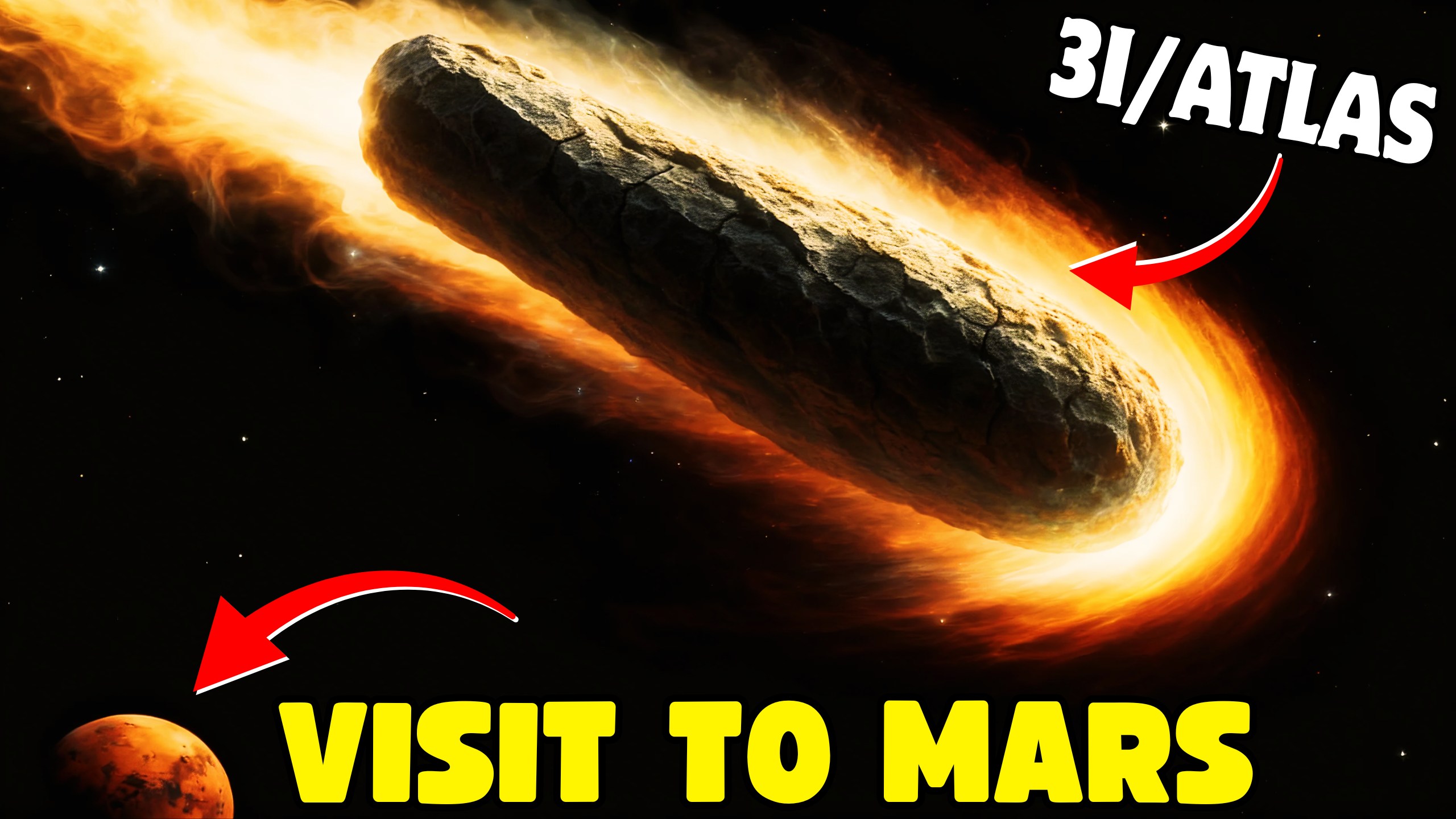
Recentemente, nosso Sistema Solar recebeu um mensageiro vindo das profundezas da Via Láctea, desencadeando um esforço de observação sem precedentes que cruzou as fronteiras de agências espaciais globais.

Este visitante não é outro senão o cometa interestelar 3I/ATLAS, e seu balé cósmico o levou a passar perigosamente perto de Marte, oferecendo uma oportunidade de estudo extraordinária. Após a histórica captura inicial de imagens pelo rover Perseverance, da NASA, a Agência Espacial Europeia (ESA) entrou em ação com suas sofisticadas espaçonaves que atualmente orbitam o Planeta Vermelho, transformando a vigilância de Marte em um posto avançado de astronomia interestelar. A raridade e a velocidade desses objetos, que não estão ligados gravitacionalmente ao nosso Sol, tornam cada observação um tesouro científico. Ver o 3I/ATLAS cruzando o céu marciano não é apenas uma curiosidade visual, mas a chance de capturar fragmentos de matéria formados em um sistema estelar totalmente diferente. Este esforço colaborativo, combinando robôs na superfície e satélites em órbita, demonstra a complexidade e a dedicação da ciência moderna em desvendar os segredos desses forasteiros celestes, que viajam a distâncias incalculáveis há milênios, portando um registro único do Universo distante.
A caçada ao 3I/ATLAS foi um verdadeiro trabalho de equipe interplanetário, orquestrado para capturar o máximo de dados possível enquanto o cometa sobrevoava Marte. O momento chave das observações pela ESA ocorreu entre 1º e 7 de outubro, período em que os satélites ExoMars Trace Gas Orbiter (TGO) e Mars Express foram realocados de sua rotina de mapeamento atmosférico e superficial do planeta para se tornarem caçadores de cometas. As equipes da ESA direcionaram suas potentes câmeras para o espaço profundo em busca desse “forasteiro cósmico”, que estava a incríveis 30 milhões de quilômetros de distância no momento dos cliques. Essa distância astronômica sublinha a façanha técnica envolvida, pois significa que a imagem capturada representa o objeto interestelar no contexto da órbita marciana. A coordenação para reorientar simultaneamente múltiplos orbitadores para um alvo tão diminuto e fugaz é complexa, exigindo cálculos orbitais extremamente precisos e um gerenciamento de tempo impecável. Os dados coletados, apesar dos desafios inerentes à distância, prometem fornecer a melhor visão já obtida de um objeto interestelar tão ativo em sua passagem próxima.
O principal obstáculo para a ESA não era apenas a distância, mas o próprio design de suas ferramentas. As câmeras a bordo do TGO e do Mars Express foram meticulosamente calibradas e projetadas ao longo de anos para um único propósito: registrar com clareza detalhes finos da superfície e da fina atmosfera de Marte, objetos que ficam a apenas algumas centenas de quilômetros de suas lentes. Mudar essa perspectiva para observar algo tão pequeno, infinitamente mais distante e inerentemente “apagado” foi, portanto, um desafio técnico colossal. Era como pedir a um fotógrafo especializado em retratos de paisagens para subitamente fotografar uma abelha a cinco quilômetros de distância. A fraca luz refletida pelo 3I/ATLAS, combinada com a sua velocidade relativa e a necessidade de longas exposições para capturar sua luz fantasmagórica, exigiu que os operadores da missão realizassem ajustes radicais nos parâmetros de imagem, testando os limites de sensibilidade dos instrumentos. A capacidade de registrar o cometa interestelar nessas condições demonstra a flexibilidade e o potencial latente dos orbitadores em Marte para além de suas missões primárias de exploração planetária.
Dentre os instrumentos utilizados, o CaSSIS (Sistema de Imagens de Superfície Coloridas e Estéreo), a bordo do ExoMars TGO, se destacou por sua notável capacidade de ajuste. Este instrumento conseguiu registrar uma sequência vital de fotografias que confirmou a localização e a passagem do cometa 3I/ATLAS. O resultado visual, embora tecnicamente complexo, é revelador: as imagens mostram um minúsculo ponto branco, que se move lentamente através do campo estelar. Este ponto tênue, no entanto, carrega uma enorme riqueza de informações científicas. Ele representa a porção mais concentrada e brilhante do cometa: seu núcleo gelado e rochoso, envolto em uma nuvem difusa de gás e poeira conhecida como coma, ou popularmente apelidada de “cabeleira”. Foi essa nuvem difusa, e não o núcleo sólido, que o CaSSIS conseguiu iluminar. O sucesso do TGO em registrar essa assinatura cósmica confirma a eficácia das exposições longas e controladas, garantindo que mesmo os objetos mais fracos e distantes pudessem deixar sua marca nos sensores da ESA.
O núcleo do cometa 3I/ATLAS possui um diâmetro estimado de apenas cerca de um quilômetro – um tamanho surpreendentemente diminuto para um objeto que viaja por sistemas estelares. Essa pequena escala, combinada com a distância de dezenas de milhões de quilômetros das câmeras da ESA, tornou o núcleo rochoso e sólido do cometa inatingível para os equipamentos de imagem. A ESA utilizou uma analogia notável para ilustrar o desafio: distinguir o núcleo seria tão difícil quanto tentar enxergar, a olho nu, um celular abandonado na superfície da Lua, estando nós na Terra. Essa comparação ressalta a escala astronômica envolvida. No entanto, o brilho difuso da coma é o que salva a observação. A coma é uma gigantesca nuvem de gás e poeira que pode se estender por milhares de quilômetros, envolvendo o núcleo e atuando como um “farol” que reflete a luz solar, permitindo que a ESA detectasse o cometa mesmo a uma distância colossal. Portanto, embora não possamos ver a rocha central, estamos vendo o rastro de sua interação com o Sol, uma assinatura vital de sua composição.
A formação da cabeleira, ou coma, é um processo dinâmico e fascinante, fundamental para a classificação e estudo dos cometas. O fenômeno começa quando o objeto interestelar se aproxima o suficiente do Sol. O aumento de calor provoca a sublimação – a transição direta do estado sólido para o gasoso – do gelo volátil (como água congelada e dióxido de carbono) contido no núcleo rochoso. Essa liberação de gases e poeira cria o halo luminoso, ou cabeleira, que pode se expandir vastamente. Em muitos cometas, essa nuvem dá origem a uma cauda longa e icônica, que é sempre empurrada na direção oposta ao Sol pela pressão da radiação e pelo vento solar. Nas imagens capturadas pelo CaSSIS, a cauda ainda não estava claramente visível, indicando que o 3I/ATLAS ainda estava relativamente distante e com baixa atividade de liberação de material. Contudo, a expectativa dos cientistas é alta: à medida que o cometa inevitavelmente se aproximar ainda mais do Sol, a atividade de sublimação se intensificará drasticamente, e a cauda deverá se formar e se tornar um espetáculo observável, revelando mais sobre a trajetória e o comportamento do objeto.
O sucesso do TGO, infelizmente, não foi replicado inicialmente pela outra sonda envolvida, a Mars Express. Suas exposições de meio segundo se mostraram muito curtas para capturar a luz fraca de um objeto tão distante e apagado, enquanto o TGO utilizou exposições até cinco vezes mais longas. Esse contratempo técnico forçou os cientistas a voltarem à prancheta. Atualmente, há um esforço intenso para combinar e ajustar as imagens registradas pela Mars Express, utilizando técnicas de processamento digital para tentar aumentar o contraste e, quem sabe, revelar o cometa que estava oculto pelo curto tempo de exposição. Contudo, o trabalho mais importante e potencialmente mais frutífero reside na análise dos dados de espectrômetros de ambas as espaçonaves. Estes instrumentos vitais medem o tipo específico de luz refletida pelos objetos cósmicos. Ao estudar o espectro do 3I/ATLAS, os cientistas esperam identificar a assinatura química dos elementos gasosos e da poeira que compõem a cabeleira e a potencial cauda. Esse é um passo crucial para decifrar a composição química do cometa, oferecendo pistas sobre o ambiente de seu sistema estelar de origem.
O cometa 3I/ATLAS detém um status notável: é apenas o terceiro objeto interestelar formalmente observado pela humanidade, seguindo o misterioso ‘Oumuamua (2017) e o mais clássico 2I/Borisov (2019). Esses corpos cósmicos são, essencialmente, cápsulas do tempo e mensageiros intergalácticos, pois se originaram em sistemas estelares alienígenas e foram arremessados para o nosso Sistema Solar por forças gravitacionais extremas. Eles trazem consigo pistas inéditas sobre os processos de formação de planetas e estrelas em regiões distantes e inexploradas da Via Láctea, oferecendo uma amostra de materiais que nunca poderíamos acessar de outra forma. A análise de sua composição é equivalente a um estudo forense cósmico. Segundo Colin Wilson, cientista da ESA, “é extremamente emocionante ver nossos orbitadores, que normalmente são dedicados a estudar Marte em detalhes, reagindo a eventos inesperados como este e provando sua versatilidade”. A capacidade de reorientar rapidamente esses ativos para estudar esses raros visitantes sublinha a maturidade das missões em Marte e o profundo impacto que esses estudos levarão à nossa compreensão da ecologia galáctica e da formação de sistemas solares vizinhos.

O fluxo de dados e o sucesso da observação do 3I/ATLAS solidificam a necessidade de missões dedicadas à captura desses raros fenômenos. Por isso, a ESA está preparando a inovadora missão Comet Interceptor, com lançamento planejado para 2029. Trata-se de um observatório espacial concebido para aguardar, em um ponto estratégico, que um cometa primitivo – ou, idealmente, outro objeto interestelar – passe perto o suficiente para ser interceptado por uma das sondas secundárias da missão. Michael Kueppers, cientista do projeto, lembra que quando a missão foi idealizada em 2019, apenas um objeto interestelar era conhecido. Hoje, a frequência de descobertas já mostra que “há mais deles e que são muito diferentes entre si”, reforçando a urgência da missão. Interceptar e estudar de perto um desses corpos pode nos oferecer a chave para entender sua origem e natureza, respondendo a perguntas fundamentais sobre a matéria primordial que compõe nossa galáxia. Mesmo que a missão não encontre um visitante interestelar imediatamente, ela servirá como um teste pioneiro vital para futuras operações de resposta rápida, garantindo que a humanidade esteja preparada para estudar esses fragmentos cósmicos que continuam a atravessar nosso sistema estelar.
Recently, our Solar System received a messenger from the depths of the Milky Way, sparking an unprecedented observation effort that has crossed the boundaries of global space agencies. This visitor is none other than the interstellar comet 3I/ATLAS, and its cosmic ballet has brought it perilously close to Mars, offering an extraordinary opportunity for study. Following the historic initial image capture by NASA’s Perseverance rover, the European Space Agency (ESA) sprang into action with its sophisticated spacecraft currently orbiting the Red Planet, transforming Mars surveillance into an outpost of interstellar astronomy. The rarity and speed of these objects, which are not gravitationally bound to our Sun, make each observation a scientific treasure. Seeing 3I/ATLAS streaking across the Martian sky is not only a visual curiosity, but a chance to capture fragments of matter formed in an entirely different star system. This collaborative effort, combining surface-based rovers and orbiting satellites, demonstrates the complexity and dedication of modern science in unlocking the secrets of these celestial aliens, which have traveled incalculable distances for millennia, bearing a unique record of the distant Universe.
The hunt for 3I/ATLAS was a true interplanetary team effort, orchestrated to capture as much data as possible as the comet flew past Mars. The key moment for ESA’s observations occurred between October 1st and 7th, when the ExoMars Trace Gas Orbiter (TGO) and Mars Express satellites were reassigned from their routine atmospheric and surface mapping of the planet to become comet hunters. ESA teams turned their powerful cameras into deep space in search of this “cosmic alien,” which was an incredible 30 million kilometers away at the time of the capture. This astronomical distance underscores the technical feat involved, as it means the captured image represents the interstellar object within the context of Martian orbit. Coordinating the simultaneous reorientation of multiple orbiters toward such a tiny, fleeting target is complex, requiring extremely precise orbital calculations and impeccable timing. The data collected, despite the inherent challenges of distance, promises to provide the best view ever obtained of such an active interstellar object in its close passage.
The main obstacle for ESA was not only the distance, but the very design of its instruments. The cameras onboard TGO and Mars Express were meticulously calibrated and engineered over years for a single purpose: to clearly record fine details of the surface and thin atmosphere of Mars, objects that lie only a few hundred kilometers from their lenses. Changing this perspective to observe something so small, infinitely more distant, and inherently “dim” was, therefore, a colossal technical challenge. It was like asking a landscape photographer to suddenly photograph a bee from five kilometers away. The faint light reflected by 3I/ATLAS, combined with its relative speed and the need for long exposures to capture its ghostly light, required mission operators to make radical adjustments to imaging parameters, testing the sensitivity limits of the instruments. The ability to image the interstellar comet under these conditions demonstrates the flexibility and latent potential of Mars orbiters beyond their primary planetary exploration missions.
Among the instruments used, the CaSSIS (Color and Stereo Surface Imaging System), aboard ExoMars TGO, stood out for its remarkable adjustment capabilities. This instrument managed to capture a vital sequence of photographs that confirmed the location and passage of comet 3I/ATLAS. The visual result, while technically complex, is revealing: the images show a tiny white dot, moving slowly across the star field. This faint dot, however, carries an enormous wealth of scientific information. It represents the most concentrated and brightest portion of the comet: its icy, rocky nucleus, enveloped in a diffuse cloud of gas and dust known as the coma, or popularly nicknamed the “coma.” It was this diffuse cloud, not the solid nucleus, that CaSSIS was able to illuminate. TGO’s success in capturing this cosmic signature confirms the effectiveness of long, controlled exposures, ensuring that even the faintest and most distant objects could leave their mark on ESA’s sensors.
The nucleus of comet 3I/ATLAS has an estimated diameter of only about a kilometer—a surprisingly small size for an object traveling through star systems. This small scale, combined with the tens of millions of kilometers away from ESA’s cameras, made the comet’s rocky, solid nucleus unreachable for imaging equipment. ESA used a striking analogy to illustrate the challenge: distinguishing the nucleus would be as difficult as trying to see a cell phone left on the surface of the Moon with the naked eye from Earth. This comparison highlights the astronomical scale involved. However, the diffuse glow of the coma is what saves the observation. The coma is a gigantic cloud of gas and dust that can extend for thousands of kilometers, enveloping the nucleus and acting as a “beacon” that reflects sunlight, allowing ESA to detect the comet even from such a colossal distance. Therefore, although we cannot see the central rock, we are seeing the trace of its interaction with the Sun, a vital signature of its composition.
The formation of a coma, or coma, is a dynamic and fascinating process, fundamental to the classification and study of comets. The phenomenon begins when the interstellar object approaches the Sun. The increase in heat causes the sublimation—the direct transition from a solid to a gaseous state—of volatile ices (such as frozen water and carbon dioxide) contained in the rocky nucleus. This release of gases and dust creates the luminous halo, or coma, which can expand vastly. In many comets, this cloud gives rise to a long, iconic tail, which is always pushed away from the Sun by radiation pressure and the solar wind. In the images captured by CaSSIS, the tail was not yet clearly visible, indicating that 3I/ATLAS was still relatively distant and experiencing low outgassing activity. However, scientists’ expectations are high: as the comet inevitably approaches the Sun, sublimation activity will dramatically intensify, and the tail should form and become an observable spectacle, revealing more about the object’s trajectory and behavior.
TGO’s success, unfortunately, was not initially replicated by the other spacecraft involved, Mars Express. Its half-second exposures proved too short to capture the faint light of such a distant and faint object, while TGO used exposures up to five times longer. This technical setback forced scientists to go back to the drawing board. Currently, an intense effort is underway to combine and adjust the images recorded by Mars Express, using digital processing techniques to try to increase contrast and, perhaps, reveal the comet that was hidden by the short exposure time. However, the most important and potentially most fruitful work lies in analyzing data from the spectrometers on both spacecraft. These vital instruments measure the specific type of light reflected by cosmic objects. By studying the 3I/ATLAS spectrum, scientists hope to identify the chemical signature of the gaseous elements and dust that make up the coma and potential tail. This is a crucial step in deciphering the comet’s chemical composition, offering clues about the environment of its star system of origin.
Comet 3I/ATLAS holds a remarkable status: it is only the third interstellar object formally observed by humanity, following the mysterious ‘Oumuamua (2017) and the more classic 2I/Borisov (2019). These cosmic bodies are essentially time capsules and intergalactic messengers, having originated in alien star systems and been flung into our Solar System by extreme gravitational forces. They bring with them unprecedented clues about the formation processes of planets and stars in distant, unexplored regions of the Milky Way, offering a sample of materials we could never otherwise access. Analyzing their composition is equivalent to cosmic forensics. According to ESA scientist Colin Wilson, “It is extremely exciting to see our orbiters, which are normally dedicated to studying Mars in detail, reacting to unexpected events like this and proving their versatility.” The ability to quickly repurpose these assets to study these rare visitors underscores the maturity of Mars missions and the profound impact these studies will have on our understanding of galactic ecology and the formation of neighboring solar systems.
The influx of data and the success of the 3I/ATLAS observations solidify the need for missions dedicated to capturing these rare phenomena. Therefore, ESA is preparing the innovative Comet Interceptor mission, scheduled for launch in 2029. This is a space observatory designed to wait, at a strategic point, for a primitive comet—or, ideally, another interstellar object—to pass close enough to be intercepted by one of the mission’s secondary probes. Michael Kueppers, project scientist, recalls that when the mission was conceived in 2019, only one interstellar object was known. Today, the frequency of discoveries already shows that “there are more of them, and that they are very different from each other,” reinforcing the mission’s urgency. Intercepting and closely studying one of these bodies could offer us the key to understanding their origin and nature, answering fundamental questions about the primordial matter that makes up our galaxy. Even if the mission doesn’t encounter an interstellar visitor immediately, it will serve as a vital testbed for future rapid-response operations, ensuring that humanity is prepared to study these cosmic fragments that continue to traverse our star system.
Artigos Relacionados


Sobre o Autor

Sou Fabio Russo, desenvolvedor e administrador do site Artesanato Total desde 2015. A mais de 25 anos trabalho com diversos nichos de sites na Internet, sempre presando a qualidade em todos os projetos.
0 Comentários